
 Decoding Harmonic Price Patterns
Harmonic trading is based on geometry and fractals. At its core, this approach incorporates the primary ratio and its derivatives (1.618, 0.618, etc.). Harmonic price patterns serve as indicators of potential trend retracements. These patterns reflect repeating cycles of investor psychology and often appear near significant support or resistance areas. They can also be combined with other technical analysis tools to confirm trade ideas.
👉 The best book for understanding harmonic patterns is “Harmonic Trading” by Scott M Carney.
🎲 Introduction to Harmonic Patterns
Harmonic patterns are geometry-based price formations identified on financial charts that suggest high-probability winning trades. They rely on precise Fibonacci ratios connecting distinct price swings, called legs. The key concept is that specific Fibonacci levels—such as 0.618, 1.618, and 0.786—help pinpoint potential reversal zones (PRZs), where the price is statistically more likely to change direction. Harmonic patterns generate signals of upcoming sharp reversals in currency rates, stocks, indices, and other instruments. These reversals typically occur within a price zone defined by two Fibonacci ratios:
-
The patterns tend to be more reliable on the M30 and higher timeframes.
-
Harmonic trading is considered a high-probability approach.
-
The overall win/loss ratio of harmonic trading strategies exceeds 70%.
🔄 Potential Reversal Zones (PRZs)
A Potential Reversal Zone (PRZ) is a price area on a chart where a market trend is statistically likely to reverse. PRZs are used by traders to pinpoint high-probability entry or exit points and to manage risk more effectively.
⚠️ Critical issues for trading with harmonic patterns include the following:
✅ The time to open a long or short position is when a harmonic pattern is near completion.
✅ It is more reliable to identify harmonic patterns on longer timeframes (above M30).
✅ Harmonic patterns in higher timeframes should not contradict one another.
✅ In general, the risk/reward ratio should be greater than 1:3.
✅ Each harmonic pattern behaves differently depending on market movement.
📉 A Guide to Six Key Harmonic Patterns
There are many different harmonic price patterns, but the main patterns we will explore in the following analysis are:
(1) ABCD Pattern
(2) Three-Drive Pattern
(3) Gartley 222 Pattern
(4) Harmonic Bat Pattern
(5) Harmonic Crab Pattern
(6) Harmonic Butterfly Pattern
(1) The ABCD Pattern
The ABCD pattern is the simplest harmonic pattern. Trading with this pattern requires the use of the Fibonacci retracement tool.

The ABCD pattern can be identified in both rising and falling markets.
-
AB and CD are the legs, while BC is the retracement.
🔢 Steps for identifying the perfect ABCD pattern:
(1) Using the Fibonacci retracement tool on AB, the BC retracement should reach the 0.618 level.
(2) Then, using the Fibonacci retracement tool on BC, the CD leg should ideally extend to 1.618.
🔀 Variations of the ABCD pattern:
Alternatively, BC may reach 0.786 of AB, and CD may extend to 1.272 of BC.
📝 Extra conditions when using the ABCD pattern:
■ AB should be exactly equal in length to CD.
■ The time taken to form the AB leg should match the time taken to form the CD leg.
(2) Three-Drive Pattern
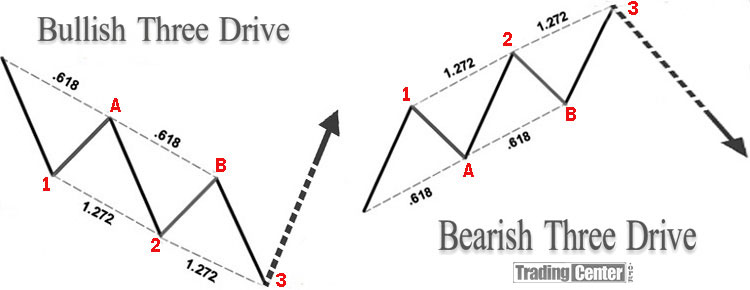
The three-drive pattern is similar to the popular Elliott Waves pattern. It also resembles the ABCD pattern, except that it has three legs instead of two. Additionally, it features two retracements rather than one.
🔢 Steps for Identifying the Three-Drive Pattern
-
Point A must be the 0.618 of Drive 1.
-
Point B must be the 0.618 retracement of Drive 2.
-
Drive 2 must be the 1.272 extension of correction A
-
Drive 3 must be the 1.272 extension of correction B.
📝 Extra Conditions when using the Three-Drive pattern:
■ The time needed for the price to form Drive-2 should be equal to the time the price needs to form Drive-3.
■ The time needed for the price to complete retracement A must be equal to the time needed to form the retracement B.

(3) Gartley 222 Pattern
Harold McKinley Gartley was a stock-market analyst and one of the first investors to apply scientific methods to explain stock market behavior. He published the book Profits in the Stock Market in 1935. Page 222 of that book introduced what is now known as the Gartley pattern. The Gartley pattern is closely related to Fibonacci numbers and is considered a high-profitability pattern with a success rate exceeding 70%.
Gartley 222 Pattern
Gartley patterns incorporate the classic ABCD pattern but are somewhat more complex. The Gartley 222 pattern is formed by five pivot or swing points. These patterns can be visualized as either a ‘W’ or an ‘M’ shape.
-
‘M’ for bullish Gartley pattern
-
‘W’ for bearish Gartley pattern

🔢 Steps for Identifying the Gartley Pattern
-
AB line must be the .618 retracement of XA
-
BC must be either the .382 or the .886 retracement of AB.
-
If BC is .382 of AB, then CD should be 1.272 of BC. On the other hand, if BC is .886 of AB, then CD should be 1.618 of BC.
-
CD should be the .786 retracement of the initial XA line
➡️ Gartley 222 and Target Price Levels
■ The first target is the price move to 0.618 of CD.
■ The second target is the price expected to move by an amount equal to the length of XA.
(4) The Crab Pattern
According to Scott Carney, the Crab pattern is the most accurate harmonic pattern. It is characterized by a high reward-to-risk ratio and very tight stop-loss placement.

🔢 Steps for Identifying the Crab Pattern
-
AB must be the .382 or .618 retracement of the XA line.
-
BC must be a .382 or .886 retracement of the AB line.
-
If BC is .382 of AB, then CD should be 2.618 of BC. Conversely, if the move BC is .886 of AB, then CD should be 3.618 of BC.
-
CD must be the 1.618 extension of the initial XA line.
(5) The Bat Pattern
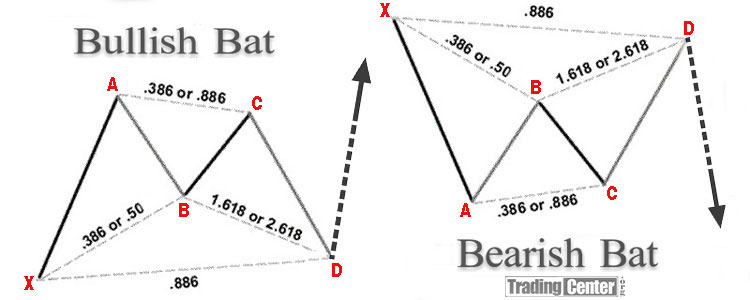
The Bat pattern is another pattern discovered by Scott Carney. It is similar to the Gartley 222 pattern but differs in the Fibonacci ratios between swings and pivots.
🔢 Steps for Identifying the Bat Pattern
-
AB must be the .382 or .50 retracement of XA.
-
BC can be either the .386 or .886 retracement of AB.
-
If BC is .386 of AB, then CD must be the 1.618 extensions of BC. Conversely, if BC is .886 of AB, then CD must be the 2.618 extensions of BC.
-
CD must be the .886 retracement of the initial XA line.
🔀 Differences between the Bat and the Gartley 222 Patterns
|
Bat Pattern |
Gartley 222 Pattern |
|
AB can retrace between 38.2 – 0.50 of XA |
AB must retrace 0.618 of XA |
|
CD can retrace up to 0.886 of the initial XA |
CD can retrace up to 0.786 of XA |
|
CD can retrace up to 1.618 – 2.618 extension of AB |
CD can retrace between the 1.13 and 1.618 extension of AB |
(6) The Butterfly Pattern
The Harmonic Butterfly is a pattern discovered by Bryce Gilmore.

🔢 Steps for Identifying the Butterfly Pattern
-
AB must be the .786 retracement of XA.
-
BC must be either the .382 or the .886 retracement of AB.
-
If BC is .382 of AB, then CD must be the 1.618 extension of BC. Conversely, if move BC is .886 of AB, then CD must be 2.618 of BC.
-
CD must be the 1.27 or 1.618 extension of the initial XA line.

 Trading Setups for Trading Harmonic Patterns
Harmonic patterns are highly profitable, with a success rate exceeding 70%. However, these patterns are rare and difficult to identify, especially for non-professionals. Many plug-ins for MT4 and MT5 claim to detect them automatically. For traders looking to spot and trade harmonic patterns, here are some basic questions that all valid setups must address:
-
Does the price action indicate the presence of a potential pattern?
-
What pattern is it?
-
Is it a basic ABCD pattern or another harmonic pattern?
-
Are there any other harmonic patterns on different timeframes that confirm or invalidate this pattern?
-
Do time cycles confirm the existence of this pattern? (Time symmetry)
-
At what point will this pattern be complete?
-
At what price will the pattern become invalid? (Place your stop-loss order according to the pattern’s price structure)
-
What is the optimal price for taking profits? (Take-profit order)
-
What is the risk/reward ratio of this trade? (Risk/reward should be above 1:2, or ideally 1:3)
-
How much of my capital should I risk on this trade? (Use leverage wisely)
 Harmonic Patterns -Final Verdict
Harmonic patterns can theoretically predict high-probability trend reversal points with favorable risk-reward ratios. When a pattern completes within its PRZ and shows a confirming signal, such as a candlestick reversal supported by strong volume, you can typically open a trade anticipating a reversal by placing a stop-loss near the PRZ. Overall, to trade successfully using harmonic patterns, you must be able to recognize the correct pattern and make precise calculations. Effective risk management is essential, as there are no certainties in financial trading, and false signals can always occur.
✅ Make sure you have identified the correct pattern.
✅ Perform precise calculations.
✅ Wait for a confirming signal before executing your trade.
✅ Set appropriate take-profit and stop-loss levels near the PRZ.
✅ Apply strict money management to protect against unforeseen market conditions.
■ Decoding Harmonic Patterns
George Protonotarios for Trading Center (c) -All rights reserved
L MORE ON TECHNICAL ANALYSIS • COMPARE • TECHNICAL ANALYSIS • INDICATORS • CYCLICAL ANALYSIS • LEARNING
□ Forex Brokers Comparison
□ Expert Advisors (EAs)
□ Broker Reviews
□ Learning
» Technical Analysis Guide
» Trading Chart Patterns
» Naked Charts & Price Zones
» Forex Technical Analysis
» Fibonacci Primes Sequence
» Harmonic Price Patterns
» RSI Precision
» PriceMomentum Chart
» CVD Indicator
» Key Technical Indicators
» ΔMP and Σ(ΔMP) Indicators
» Wyckoff Method
» TD Sequential
» Hurst Nominal Cyclical Model
» Elliott Wave Principle
» Forex Pairs
» Trading Books
» Trading Tips
