
 Through his account of the Peloponnesian War, Thucydides highlighted a dilemma that can arise from the rivalry between two major geopolitical powers. Centuries later, Graham Allison introduced the term 'Thucydides Trap' to describe the risk of conflict between an established and a rising global superpower.
The Enduring Clash Between an Established and an Emerging Superpower
In 432 BC, the assembly of Spartan citizens (Apella) decided to declare war on Athens. This decision was based on the belief that within a few years, Athenian power would grow to such an extent that it would threaten Sparta’s very survival. The rapid rise of Athens had already disrupted the balance of power, prompting Sparta to launch a preemptive war.
A similar geopolitical pattern that led to the Peloponnesian War appears to be taking shape today between the United States and China. Many American analysts believe that within the next 10-15 years, China will have accumulated enough economic and military power that the U.S. will no longer be able to contain full Chinese dominance. From this perspective, the argument is made that the window for the U.S. to limit China’s rise may be today. As such, there are clear parallels between the geopolitical dilemma that led to the Peloponnesian War and today’s global environment.

Both the U.S. and China hold strong advantages over each other; let's examine some of their strengths and weaknesses.
- Economic Landscape
The U.S. economy (GDP) is currently about 50% larger than China’s, while the dollar remains the dominant global currency, accounting for roughly 89% of all foreign exchange transactions. On the other hand, China is growing at roughly twice the rate of the U.S. and is a less indebted economy. Specifically, U.S. public debt stands at 120.8% of GDP, compared to China’s 88.3% (IMF data, 2024). China also holds around $3.4 trillion in foreign exchange reserves, including a significant share of U.S. government debt.
Concerning trade balance, China’s total trade surplus reached $1.2 trillion in 2025, with $202 billion of that coming from trade with the U.S.
- Technological Landscape
Both countries possess strong technological and research infrastructures along with a vast pool of highly skilled personnel, and are also investing hundreds of billions of dollars annually. The U.S. leads in the internet and AI sectors and benefits from a powerful capital base, spearheaded by Wall Street. As of early 2026, the NASDAQ-100 alone is valued at approximately $30 trillion.
China, meanwhile, dominates the global process of transforming any new technology into mass production. Its manufacturing sector accounts for roughly 30% of total global output, rising to an impressive 50% in electronics.
- Military and Diplomatic Landscape
The U.S. undeniably maintains the most powerful military in the world, with superiority across land, air, sea, and space. On the other hand, China’s military capabilities are significantly behind, but expanding at a rapid pace. In terms of alliances, the U.S. has more and stronger allies -but also more enemies.

The U.S. Strategy to Contain China
If current trends continue, China is expected to become the world’s largest economy within 12-15 years, allowing it to invest more in technological and military infrastructure than any other nation. By contrast, the U.S. may lose its position as the world’s leading economy, with its debt-to-GDP ratio projected to exceed 130% after 2030. In the event of a global economic downturn, which historically occurs roughly every 40 years, U.S. deficits and public debt could rise even more sharply. This issue was presented in a previous analysis by TradingCenter:
🔗 https://tradingcenter.org/index.php/learn/fundamental-analysis/390-global-debt-crisis-us-eurozone
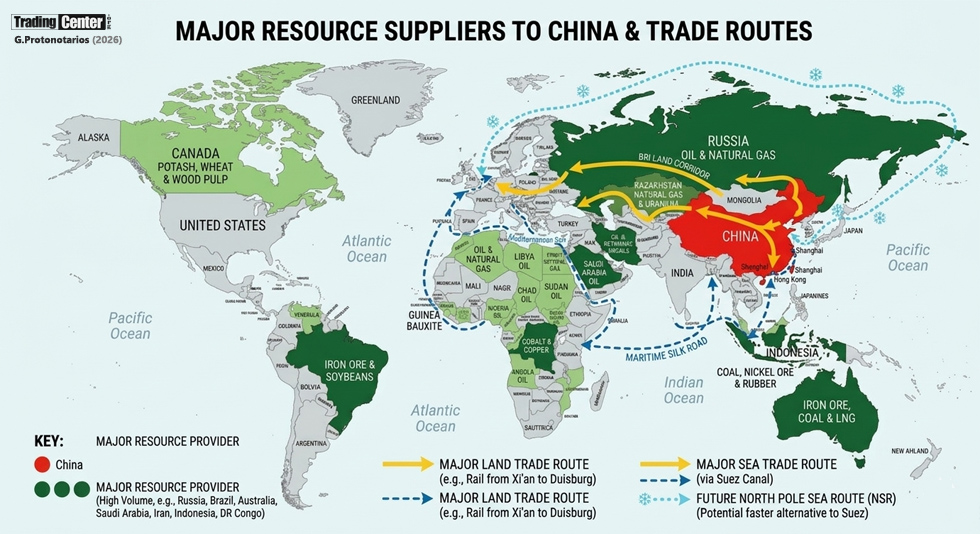
Within this context, the U.S. recognizes that maintaining global leadership will require limiting China’s expansionist ambitions today. This includes efforts to influence key countries along the modern ‘Silk Road’ between China and Europe, as well as limiting China’s access to critical energy and resource supplies. This helps explain military involvement in countries that supply energy and other strategic resources to China. Recently, Donald Trump also showed a strong interest in controlling Greenland, partly due to the emerging Arctic trade route between China and Europe as polar ice melts. The following map shows the countries that supply China with major strategic resources and the trade routes (land/sea) connecting China with Europe.
Map: Major Resource Suppliers to China & Trade Routes
The Critical Flashpoint
Taiwan is widely expected to be the key flashpoint in any escalation between the U.S. and China. In the event of a conflict, part of the U.S. strategy would involve a naval blockade of China, supported by a network of military bases surrounding it. China, on the other hand, has invested in artificial islands and possesses over 3,000 anti-ship missiles.
What seems certain is that tensions between the two powers will intensify over the next decade. The hope, however, is that this escalation does not lead to direct military conflict. The lesson from the Peloponnesian War is clear: when two superpowers go to war, there are no true winners.
■ Global Markets under the 'Thucydides Trap'
Giorgos Protonotarios, Economic Analyst
TradingCenter.org © – April, 6th, 2026
Sources:
- Graham Allison, Destined for War: Can America and China Escape Thucydides's Trap?, Houghton Mifflin Harcourt, 2017, 389 pp.
- https://www.worldometers.info/gdp/gdp-by-country/?utm
- https://www.imf.org/external/datamapper/NGDP_RPCH@WEO/OEMDC/ADVEC/WEOWORLD/USA
- https://www.imf.org/external/datamapper/GG_DEBT_GDP@GDD/CHN/FRA/DEU/ITA/JPN/GBR/USA/FADGDWORLD
- https://www.bea.gov/news/2026/us-international-trade-goods-and-services-december-and-annual-2025
- https://www.bis.org/statistics/rpfx25_fx.htm?utm
L MORE TUTORIALS
|
• GENERAL GUIDES |
□ Equity Trading |
|
|||
| • OTHER RESOURCES | » Trading Tips | » CFD Brokers |
