
YOUR TRADING JOURNEY BEGINS AT TRADINGCENTER.ORG
Training before trading with real money means acquiring knowledge, experience, skills, and mental discipline. Proper training can turn trading from a gamble into a strategy based on rules. When training is ongoing, your chances of long-term success improve, while risks and mistakes are reduced.
① Trading Strategy
A trading strategy is a plan for opening and closing positions based on fixed rules and setups. Its goal is to achieve strong long-term returns by managing risk through money management (MM) and minimizing the influence of emotions like fear and greed.
In this section, you will find information on the following types of trading strategies:
- Intraday Trading Strategies
- Swing-Trade Strategies
- Automated Trading Strategy
- Arbitrage Trading Strategies
🔗 More: » Trade Strategy Guide | » Auto-Trade Strategies | » Equity Trading Strategies | » Arbitrage Trading Strategies
② Ten Essential Trading Rules to Always Have in Mind
These are ten important rules to follow when trading any financial market:
-
The market is unpredictable and uncertain — Don’t try to outsmart it; instead, prepare for different outcomes based on probabilities.
-
Portfolio diversification always works — Protect your money by not putting all your 'eggs' in one basket.
-
Smart money is unbeatable in the short term — Expand your trading horizon and avoid day trading completely.
-
Always consider your transaction costs — The more you trade, the higher your costs.
-
Emotional trading is dangerous — Using a trading system helps reduce the impact of emotions.
-
Limit your use of leverage — High leverage means more risk and higher costs.
-
Identify and follow strong trends — Trade in the direction of the trend, don't bet on reversals.
-
Trade against the crowd — Trading is a zero-sum game, and the crowd usually ends up on the losing side.
-
Cut your losses and let your profits run — Don’t rush to close winning trades.
-
Combine fundamental and technical analysis — Fundamentals tell you what to buy; technicals tell you when to buy.
③ Technical Analysis Guide

Technical analysts use charts, patterns, indicators, and oscillators to spot similarities between current and past market behavior that may suggest future price movements. This method can be applied to all asset classes, including stocks, indices, Forex pairs, and commodities. Technical analysts focus on two main questions:
(i) What is the current price of a traded asset?
(ii) What is the asset’s price history?
While technical analysis can't predict the future, it helps traders assess the likelihood of a trend continuing or reversing. Most importantly, it helps identify the best time to enter or exit the market.
🔗 More: » The Technical Analysis Guide on TraingCenter.org
④ RSI Precision by TradingCenter.org (The First All-in-One TA Indicator -Free from TradingCenter.org)

RSI PRECISION is an enhanced version of the classic Relative Strength Index (RSI) by Giorgos Protonotarios and Tradingcenter.org. It is designed to improve accuracy on longer timeframes. In addition, it functions as an advanced signaling tool, providing five categories of leading trading signals: RSI, MACD, StochRSI, SMA, and Golden/Death Crosses.
This new oscillator combines RSI readings with price momentum and volatility, making it especially useful for analyzing highly volatile markets such as Bitcoin or penny stocks. RSI PRECISION also includes a wide range of customizable settings, including crossover and cross-under alerts.
📌 Add RSI Precision on TradingView: » https://www.tradingview.com/script/cTEWnHdU-RSI-PRECISION-v-3
📌 Trading Signals: RSI cross | MACD signal line cross | StochRSI cross | SMA cross | Golden/Death cross
🔗 More: » More about the RSI Precision Indicator
⑤ ΔMP and Σ(ΔMP) Indicators
TradingCenter is continuously striving to provide the trading community with innovative technical analysis tools and techniques. The goal is to help traders better analyze financial markets and gain a clearer understanding of the cyclicality present in certain asset classes. ΔMP is the latest technical analysis tool developed by Giorgos Protonotarios. It is an indicator that can be applied to any financial asset and is compatible with nearly any chart timeframe.
Introducing ΔMP -Measuring Momentum using Historical Intraday Ranges
The purpose of ΔMP is to measure and visualize the historical momentum of any Forex pair or other financial-traded asset. ΔMP and Σ(ΔMP) technical analysis indicators were introduced in the following book:
The Importance of ΔMP
ΔMP measures the divergence between the closing price and the mean price. Consecutive positive ΔMP values indicate that an asset’s price consistently closes near its highest intraday level. This signals strong positive momentum in intraday demand and supply dynamics. Generally, when ΔMP remains highly positive over a period, the likelihood of favorable returns during that period increases.
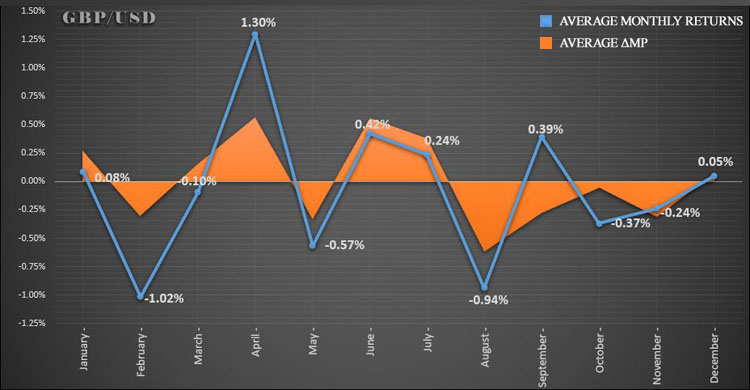
Let’s take GBPUSD as an example.
In the following GBPUSD chart, two variables are shown:
(i) The blue line represents the average monthly returns of GBPUSD from 2000 to 2018.
(ii) The orange area represents the average monthly ΔMP over the same period.
Chart: Average Returns & Average ΔMP on GBPUSD (period 2000–2018)
🔗 More: » More on ΔMP and Σ(ΔMP) Indicators | » eBook at Amazon including ΔMP Charts & Statistics
⑥ Trading Center Indicator (TCI)

Trading Center, drawing from extensive trading experience, has developed a unique trading indicator called TCI (Trading Center Indicator). TCI can be used to analyze any traded financial asset, on any timeframe, both historically and into the future.
TCI Concept: “Look backward to identify what to buy, then look forward to decide when to buy it.”
TCI uses key daily activity data—such as opening price, high and low prices, trading volume, and trading value. It is built on two moving averages that incorporate all this trading activity:
-
Moving Average (1) provides a daily valuation
-
Moving Average (2) corrects and adjusts those values
Each moving average is calculated independently.
Looking Backward and Forward
The two moving averages in TCI can be configured for either a backward- or forward-looking timeframe:
(1) When set backward, TCI helps identify overbought and oversold conditions
(2) When set forward, TCI helps forecast optimal trade entry and exit timing
🔗 More: » More on TCI Models
⑦ The Optimal Trading Leverage Formula
“Building a Simple Money Management System to Trade Derivatives & Forex”
When we identify a potentially profitable trade, we must decide how much capital we are willing to risk on that position. This is a critical decision, as larger trade sizes can lead to significant profits—but also substantial losses. Trading is a game of probabilities, not certainties, and as has often been mentioned in TradingCenter, trading leverage can be your greatest ally or your worst enemy.
The following trading leverage formula is designed to provide a simple framework for evaluating the attractiveness of each trade and, accordingly, selecting the ideal leverage ratio.
The Simple Trading Leverage Formula
Here is the formula (briefly explained in the following article):
🧮 Optimal Leverage Formula = [ (P/L) * (1/Spread) * (R/2) ] %
Where: (P/L) = Profit to Loss Ratio
Spread = the difference between the bid and ask prices (in pips)
(R) = Risk Tolerance (values 1-20)
🔗 More: » The Trading Leverage Formula
 ⑧ Financial Ratios
Financial or accounting ratios are tools used to measure a company's profitability, efficiency, and financial stability. They help assess how well or poorly a company is managed. These ratios can also be used to compare the fair value of different companies or even entire industries.
The Four Major Categories of Financial Ratios:
-
Balance Sheet Ratios – Measure financial stability, including liquidity and solvency
-
Operating Ratios – Measure business performance
-
Efficiency Ratios – Measure how effectively resources are used
-
Valuation Ratios – Measure market value and investment effectiveness
🔗 More: » More About Financial Ratios
⑨ Trading-Seminars
Trading seminars can be an effective way to improve your trading skills. Today, there are many available, and the tips below can help you choose the right one.
(i) Identify your needs and choose a trading topic that suits you
(ii) Match the seminar to your experience level
(ii) Avoid seminars that promote products or services
(iv) Check the experience level of the seminar instructor
(v) Use the seminar location as a clue
🔗 More: » Trading Seminars and Tips
⑩ Find Trading Books
Reading trading books is a necessary step for success in the financial markets. Good trading books can offer a deep understanding of how markets work and highlight what traders should focus on. Additionally, they can help traders develop important skills like discipline and patience.
You may find some interesting trading books here:
🔗 More: » Stock-Trading Books | » Forex Trading Books | » Commodity-trading Books
⑪ Forex Rating Formula –Financial Brokers and the Need for a 100% Objective Rating Framework
The Rating Formulas developed by Giorgos Protonotarios and TradingCenter.org introduce a new way of evaluating financial services. Today, most broker ratings found online are based on user reviews. Research shows that more than 50% of these reviews are fake. Brokers often have strong incentives to pay for fake positive reviews or negative ones against their competitors.
This series of Rating Formulas aims to solve that problem by offering a 100% objective framework for evaluating brokers. So far, two categories of financial services have been rated: Forex Brokers and Binary Options Brokers. The new Rating Formula v5.0 is specifically designed for Forex Brokers, featuring several important innovations.
🆕 What’s New in Version 5.0 of the Rating Formula:
👉 The number of core rating factors has been reduced to three focused categories to improve clarity and relevance:
- Safety of Funds {weight 25%}
- Transaction Cost {weight 40%}
- Trading Options & Technology {weight 35%}
👉 The formula now produces four separate rating values:
-
One for each trading style (Intraday, Swing, Long-Term)
-
One Overall Rating, calculated as the average of the three.
🔗 More: » More About the Forex Rating Formulas
⑫ TradingCenter News Blog
Keeping up with financial news is essential for understanding where the markets are heading. Major macroeconomic events and policy changes can directly influence investment decisions. Staying informed helps investors think more strategically and refine their market outlook.
- Explore the latest news and promotions in the trading industry
🔗 More: » Learning at Trading Center | » Trading with TradingCenter
L MORE TRAINING RESOURCES • COMPARE • GENERAL RESOURCES • MONEY MANAGEMENT • STRATEGY
□ Forex Brokers Comparison
□ Expert Advisors (EAs)
□ Reviews
» Trading Books
» Financial Ratios
» Rating Formulas
» RSI Precision
» TCI Forecasting Models
» ΔMP and Σ(ΔMP) Indicators
» Risk-Adjusted Portfolio Ratios
» Investment Risks
» The Rules of 72, 115, and 144
» The Optimal Leverage Formula
» Trade Strategy Guide
» Automated Forex Trading Strategies
» Equity Day-Trade Strategies
» Forex Price Action
» StrategyQuant Review
