

Trading “naked” means using clean charts without any technical indicators. Clean charts can be helpful, but they require precise identification of price zones. These zones are general areas of support and resistance where prices are likely to consolidate or even reverse.
The following article offers information and tips on trading naked charts. It is partly based on the book Naked Forex: High-Probability Techniques for Trading without Indicators by Alex Nekritin and Walter Peters. The charts were created by the author.
The Advantages of Trading with Naked Charts
The key to trading naked charts is correctly identifying support and resistance levels. By combining these levels, you can create two important price zones (S&R). These zones form two boxes on the chart (explained later) and help traders easily identify:
- The general direction of the market (higher highs/lows)
- Strong trends (bullish/bearish)
- Consolidating markets (ranging between the support and resistance boxes)
- Breakouts (when the price manages to break out of support or resistance zones)
- False breakouts (when the market retraces)
The clean-chart approach is commonly used by currency traders, but it can be applied by traders in any market.
Price Zones -The Quest for the Sweet Spot on the Chart
By studying historical charts across different markets, we can see that certain price levels tend to repeatedly trigger reversals. These levels are important for all traders, especially those trading “naked.”
Combining support and resistance on a chart creates key price zones. Once a price zone is identified, a skilled trader can spot potential trade opportunities. If prices have consistently reversed at certain levels in the past, those levels are likely to remain significant in the future.
The example below shows the price zones of Bitcoin versus the US dollar on the daily chart.
Chart: Bitcoin versus the US dollar (daily)

Key Characteristics of a Price Zone
These are some key features:
- Price zones form areas of significance, not price points
- Price trends tend to reverse near key zones
- Price zones are getting better with age
- Price zones rarely need to be modified
Identifying a price zone is important, but not enough
Support and resistance levels create key zones on the chart that are important for trading. However, simply identifying a price zone is not enough to trade successfully. A naked trader will not enter a trade just because the price reached a significant zone. The trader requires multiple confirmations before deciding if and when to trade. At the same time, a trade will only be considered if the price has reached a price zone, making the confirmation of that zone the first step in creating a setup.
Here are some basic facts:
- The precise identification of a price zone may lead to the creation of a trade setup
- The naked trader will only accept a trade if the price has reached a price zone
- If the price is reaching a price zone, the naked trader stays on alert
- The naked trader will need several confirmations to take the trade
How to Create the Price Zones of Significance
In many cases, the identification of support and resistance is obvious and easy to draw on the chart. Nevertheless, in some other cases, it may be complex and confusing. These are some shortcuts to recognize price zones on the chart:
1️⃣ Prefer a line chart
Closing prices matter most. Line charts show only closing prices, which makes analysis simpler.
2️⃣ Begin your research on higher timeframes
Patterns on higher timeframes (monthly, weekly, or daily) are more significant. Price zones follow this rule. Lower timeframes are useful for refining the boundaries, as illustrated in the US Dollar Index chart below.
3️⃣ Consider the number of touches on a high timeframe
Many touches on a low timeframe may equal only a few on a higher timeframe. The importance of a zone depends on how often its boundaries are tested. For example, a zone with 4–5 touches on the daily chart over the past year can be seen as critical.
4️⃣ Focus on volume peaks near highs and lows
Volume is the second most important factor after price. Peaks in volume at certain levels indicate demand or supply from major market participants. Note that not all naked traders use volume.
5️⃣ Check price action at the middle of a range
Sometimes, the middle line of an important price range acts as support or resistance. This can provide an extra clue, confirming the accuracy of the range.
In the following example:
☑ drawing support and resistance on the weekly chart, and then,
☑ using the daily chart to adjust the price range.
Chart: The US Dollar Index Price Zone (Weekly & Daily)

👉 Tips for Recognizing an Important Price Zone
As mentioned above, identifying a crucial zone on the chart can sometimes be easy, and sometimes not. Here are some tips to avoid mistakes:
-
Avoid drawing more than a couple of zones; ideally, draw only one.
-
Focus on general zones of support and resistance, not exact prices. Touches near a zone may not be perfect—some can fall inside, others slightly outside.
-
Watch out for false breakouts. The price may move beyond a critical zone and then reverse. You need at least 3–4 closes above or below the zone to confirm a breakout. More details on false breakouts are provided below.
-
Volume can help confirm strong price zones and potential breakouts. Volume should increase as the price approaches a critical zone. A breakout with weak volume is likely a false breakout.

Identifying the Market Mode (Trending vs Consolidating)
Financial markets are moving in two modes: either they are following a trend or they are consolidating. What most traders are missing is that financial markets are consolidating 80-90% of all time.
☑ Choppy directionless markets (80-90% of all time)
☑ Powerful trending markets (10-20% of all time)
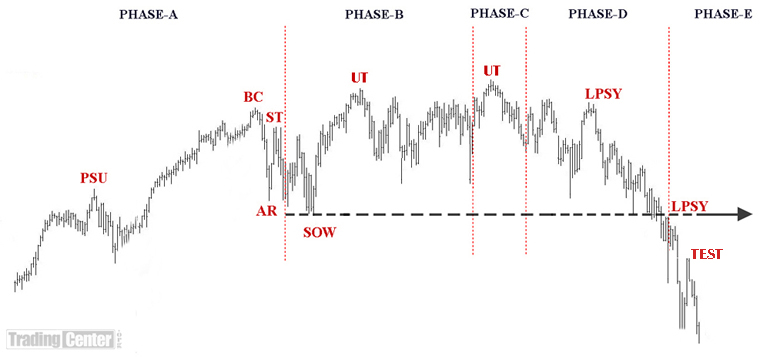
Financial markets constantly alternate between two modes. They first consolidate for a period, then move in one direction, before consolidating again. A good way to understand this two-mode behavior is by studying Wyckoff patterns.
The Wyckoff Phases
According to Wyckoff, markets follow a repeating cycle with four phases:
-
Accumulation Phase (consolidating)
-
Uptrend Phase (trending)
-
Downtrend Phase (trending)
-
Distribution Phase (consolidating)
Chart: The Wyckoff Accumulation
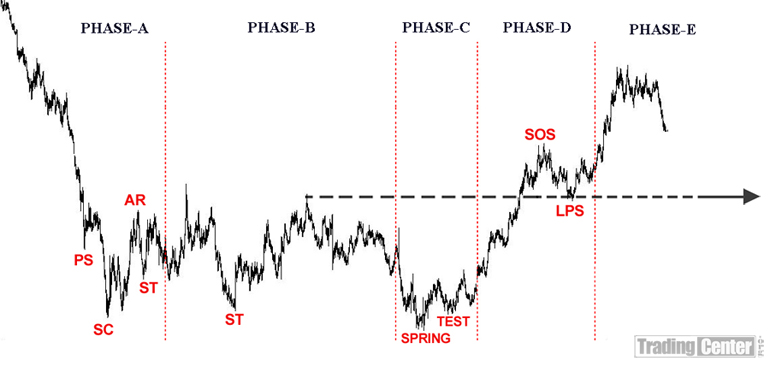
Chart: The Wyckoff Distribution
🔗 Wyckoff Patterns on TradingCenter: https://tradingcenter.org/index.php/learn/technical-analysis/329-wyckoff-method
The transition from a consolidating market to a trending market is marked by a price breakout.
Breakouts -Recognizing the Market Transition
A price breakout is the most important event on a chart for any trader. Breakouts signal a shift from a choppy, directionless market to a strong trend. The trend that follows can be powerful and highly profitable. Traders who recognize this transition early can take advantage of high-reward-to-risk trades.
Key steps for trading strong breakouts:
-
Identify a market approaching a crucial price zone.
-
Wait for the market to complete its consolidation period (this may take time and requires discipline).
-
Enter a position once the breakout is confirmed. This confirmation is called the “last kiss” and is explained later.
False Breakouts or Fake-Outs
A major challenge with breakout strategies is false breakouts, or fake-outs. This occurs when the price moves outside the consolidation zone, signaling a breakout, but then retraces back inside instead of forming a new trend. False breakouts are common because financial markets trend only 10–20% of the time. Since markets spend most of their time consolidating, false breakouts happen frequently.
False Breakouts and High-Leverage Markets
Markets with high leverage tend to produce more false breakouts. High leverage can lead market-makers to target leveraged retail positions through stop-hunting. While sometimes unethical or illegal, stop-hunting occurs in real markets.
- High leverage can indirectly cause many fake breakouts.
- Monitoring open interest can reveal high leverage in the market.
- Checking the latest COT report in the futures market helps ensure you’re not trading alongside small speculators (avoid trading in their direction).
Using Price Patterns to Confirm Breakouts
Certain price patterns can help confirm a reversal or continuation. If these patterns appear within a price zone, they provide useful clues. The most reliable patterns include:
- Rounding Top/Bottom (most reliable)
- Cup and Handle
- Head & Shoulders
Other patterns are less significant. You can find tutorials on these price patterns on TradingCenter.org.
🔗 Chart Patterns & Probabilities: » https://tradingcenter.org/index.php/learn/chart-patterns
🔗 Harmonic Price Patterns: » https://tradingcenter.org/index.php/learn/harmonic-price-patterns

Confirming the Transition -The Retouch Principle or else the ‘Last Kiss’
The retouch principle refers to a breakout setup and is called the “Last Kiss” by Alex Nekritin and Walter Peters. This setup helps traders avoid fake breakouts.
The Last Kiss Strategy for Avoiding Fake-Outs
✅ The Last Kiss method filters out many fake-outs and confirms the reliability of a breakout signal. To use this strategy, the first step is to identify the consolidation zone, as shown in previous charts.
✅ The Last Kiss trade is based on the idea that the market often returns to a significant zone after breaking and moving beyond it. Traders wait for the market to retouch the consolidation zone after the breakout before entering the trade.
The Last-Kiss Trade
Steps for Taking the Last-Kiss Trade:
-
Draw support and resistance boxes on the chart (as in previous examples)
-
Monitor the price as it consolidates inside the box
-
Be alert as the price breaks out of the zone
-
Wait for the price to return near the consolidation box
-
When the market prints a Last-Kiss candlestick at the edge of the box, take the trade
👉 Notes:
-
The Last-Kiss trade is a high-probability setup but offers no guarantees
-
Pay attention to volume. Volume usually peaks during the breakout, but during the Last Kiss, it should remain low
-
If volume spikes at the Last Kiss, it may indicate a false breakout, caused by a large buyer or seller overriding the breakout
-
Certain price patterns or Japanese candlesticks can help confirm your entry

Conclusions & the 10-Step Breakout Trading Strategy
Using too many indicators can be confusing and may lead to mistakes, which is why trading naked charts without indicators is an interesting approach. I recommend applying the naked-chart method to highly mature markets, such as the Forex market. Forex currencies are driven by strong fundamental trends, making naked charts more effective than indicator-heavy charts.
Personally, I combine naked charts with only one indicator: RSI Precision, which I developed for my trading needs and share for free. I use RSI Precision 3 on naked charts to spot divergences on higher timeframes and to identify the powerful MACD signal on the monthly chart, which I find very reliable.
🔗 More: » More about the RSI Precision series of indicators
♞ The 10-Step Breakout Trading Strategy
Here is my 10-Step Breakout Trading Strategy:
1️⃣ Analyze the market using high timeframes (Daily and above).
2️⃣ Draw major support and resistance lines on naked charts (using only closing prices) -Combine support and resistance to form price zones (two boxes).
3️⃣ Determine if the market is trending or consolidating within a crucial range -If trending, decide the direction by observing higher highs and higher lows on high timeframes.
4️⃣ Observe how the market has recently reacted near major support and resistance levels.
5️⃣ Identify potential powerful price patterns within the zone.
6️⃣ Look for RSI/MACD divergences on higher timeframes (optional for naked traders).
7️⃣ Monitor open interest and the COT (Commitments of Traders) report to understand small speculator positions—avoid trading in their direction.
8️⃣ Wait for a breakout of a major zone.
9️⃣ Confirm the breakout with volume, as explained earlier.
🔟 Wait for the ‘Last Kiss’ before entering the trade.
Happy trading!
■ Trading Naked (Charting & Price Zones)
George Protonotarios, financial analyst
For TradingCenter.org (c) October 7, 2024
🔗 Book Source: » https://www.amazon.com/Naked-Forex-High-Probability-Techniques-Indicators/dp/1118114019
L MORE ON TECHNICAL ANALYSIS • COMPARE • TECHNICAL ANALYSIS • INDICATORS • CYCLICAL ANALYSIS • LEARNING
□ Forex Brokers Comparison
□ Expert Advisors (EAs)
□ Broker Reviews
□ Learning
» Technical Analysis Guide
» Trading Chart Patterns
» Naked Charts & Price Zones
» Forex Technical Analysis
» Fibonacci Primes Sequence
» Harmonic Price Patterns
» RSI Precision
» PriceMomentum Chart
» CVD Indicator
» Key Technical Indicators
» ΔMP and Σ(ΔMP) Indicators
» Wyckoff Method
» TD Sequential
» Hurst Nominal Cyclical Model
» Elliott Wave Principle
» Forex Pairs
» Trading Books
» Trading Tips
