
 CVD (Cumulative Volume Delta) Indicator
CVD is a strong volume-based indicator that tracks cumulative volume changes from buy and sell aggressors over a set period. You can combine CVD signals with other technical analysis tools to find more reliable market entries.
The Importance and Predictive Ability of Trading Volume
Volume is a key piece of information that most market participants often underestimate. In general, price action and volume should move in harmony. Any divergence between the two can be an early signal of unstable market conditions. For example, a major trend reversal or breakout should always be backed by strong volume. If a breakout happens without significant volume, it may not hold. Likewise, a market top or bottom should be confirmed by a clear surge in volume. If a price tops with only moderate volume, the market is likely in a re-accumulation phase rather than a distribution phase.
Wyckoff argued that when price action and volume move together, it shows an established trend with a high chance of continuing. But if price and volume move randomly, the trend is more likely to consolidate or even reverse. This is why volume is so important, and why volume-based indicators like CVD can be useful in confirming any bullish or bearish outlook.

⚙️ Using Cumulative Volume Delta (CVD)
There are different versions of CVD available online, but the key focus should be on the green and red bars in the middle.
How it Works
CVD measures the delta of each bar (buying volume minus selling volume) over a set period and displays it as a sequence of green and red bars. Traders can adjust the length of the cumulative period.
□ CVD prints a green bar when the volume delta is above zero, meaning buying pressure is stronger than selling pressure.
□ CVD prints a red bar when the volume delta is below zero, meaning selling pressure is stronger than buying pressure.
It is best to use CVD on timeframes above one hour (H1), as lower timeframes often give false signals.
Setting the Periods
CVD calculates each bar over a specific period that can be adjusted. During that period, it adds up all the deltas between buying and selling volume. The default setting is 14.
CVD in Bull and Bear Markets
In a strong bull market, CVD rises steadily with a positive slope. You will see a sequence of green bars that may last for weeks. When bulls lose strength, CVD begins sloping downward. Green bars may still appear, but they become shorter, signaling trend exhaustion. Once red bars start printing, the trend reversal accelerates.
In a strong bear market, the opposite occurs. CVD prints a sequence of red bars with a negative slope as sellers dominate. When sellers lose momentum, red bars shorten and the slope turns positive. Eventually, green bars appear, signaling a reversal from bear to bull.
When CVD is Flat
During accumulation, re-accumulation, or distribution phases, CVD is usually flat. This shows that buying and selling volumes are balanced.
⇄ Combining the Cumulative Volume Delta (CVD) Indicator with Other Indicators
As with most indicators, CVD should not be used alone. It works best when combined with other tools to confirm trading signals. In our example, we use CVD together with RSI Precision. Keep in mind that RSI Precision is an improved version of the classic Relative Strength Index.
🔗 More: » Learn more about RSI Precision at TradingCenter.org
Chart: CVD & RSI Precision on the Daily Bitcoin
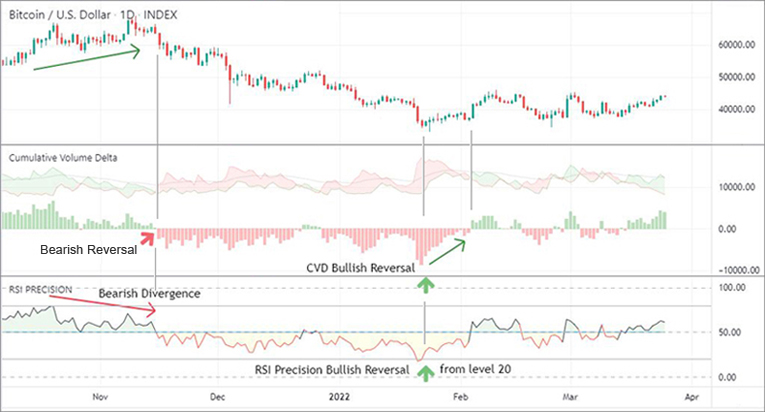
At the start of the BTC/USD chart, we see a clear divergence between the price slope and the RSI Precision slope. This is an early sign that the bullish trend is losing strength and a reversal is likely. Then, in mid-November, CVD turns red for the first time in months, signaling a sell opportunity.
In the middle of the chart, CVD shows a positive slope while RSI Precision makes a strong bullish crossover above the 20 level. This confirms a buy signal.

🧮 Cumulative Volume Delta Formula
These are the basic CVD calculations:
- Buying volume = bullish price condition X volume
- Selling volume = bearish price condition X volume
- Volume delta = difference between buying volume and selling volume
- CVD = the cumulation of volume delta for a specific period
Delta
Delta is the difference between buying and selling volumes within a given period. This period can be any candle, such as 30 minutes, 1 day, or 1 month.
- Green bars, when buyers dominate the market
- Zero, when buyers equal sellers
- Red bars, when sellers dominate the market
⌨️ Coding CVD Bar on Pinescript
For those who are using the programming language Pinescript on TradingView, this is the basic script for the CVD bar:
//@version=4
study("CVD Bar")
///Note, this script is provided for educational purposes
///INPUTS
T0 = "Within that period, CVD will cumulate all the deltas between buying and selling volume"
cvd_period = input(14, tooltip=T0, title="CVD Cumulative Period")
///BASIC CALCULATIONS
HighLow = high-low
low_close = close>open ? open-low : close-low
up_close = close>open ? high-close : high-open
candle_size = HighLow - (up_close + low_close)
candle_size_perchentage = candle_size/HighLow
low_close_perchentage = low_close/HighLow
up_close_perchentage = up_close/HighLow
bull_volume = close>open ? (candle_size_perchentage + (up_close_perchentage + low_close_perchentage)/2)*volume : ((up_close_perchentage + low_close_perchentage)/2)* volume
bear_volume = close<open ? (candle_size_perchentage + (up_close_perchentage + low_close_perchentage)/2)*volume : ((up_close_perchentage + low_close_perchentage)/2)* volume
//TIMEFRAME CALCULATIONS
adding_bull_volume_1 = ema(bull_volume,cvd_period)
adding_bear_volume_1 = ema(bear_volume,cvd_period)
cvd_delta = adding_bull_volume_1 - adding_bear_volume_1
/// PLOTS
plot(cvd_delta, color= cvd_delta>0 ? color.green : color.red, style=plot.style_columns)
Copy and paste the above script to TradingView (Pine Editor) to practice with the CVD bar. Note, this script is only provided for educational purposes, not for trading.
■ CVD (Cumulative Volume Delta) Indicator
G.P. for TradingCenter.org (c) March 2022
L MORE ON TECHNICAL ANALYSIS • COMPARE • TECHNICAL ANALYSIS • INDICATORS • CYCLICAL ANALYSIS • LEARNING
□ Forex Brokers Comparison
□ Expert Advisors (EAs)
□ Broker Reviews
□ Learning
» Technical Analysis Guide
» Trading Chart Patterns
» Naked Charts & Price Zones
» Forex Technical Analysis
» Fibonacci Primes Sequence
» Harmonic Price Patterns
» RSI Precision
» PriceMomentum Chart
» CVD Indicator
» Key Technical Indicators
» ΔMP and Σ(ΔMP) Indicators
» Wyckoff Method
» TD Sequential
» Hurst Nominal Cyclical Model
» Elliott Wave Principle
» Forex Pairs
» Trading Books
» Trading Tips
