
 〽️ Exploring Economic & Business Cycle Dynamics
What are Economic Cycles?
In general, economic cycles are periods of growth (expansion) followed by recession (contraction). The length of each cycle is influenced by key macroeconomic factors such as GDP growth, national income, inflation, consumption, and employment levels. The debt cycle plays a central role in shaping each economic cycle.
How Central Banks Influence the Length of Economic Cycles
What matters most for a central bank is achieving high employment and sustainable growth while keeping inflation under control.
In developed countries, the central bank manages money flow in the economy, primarily through interest rates. By adjusting rates, it can increase or decrease liquidity, influencing overall economic activity. Central banks also intervene by buying assets from commercial banks to boost their lending capacity, or by slowly devaluing the domestic currency to support exports and growth.
The transition from growth to recession is largely shaped by inflation and employment levels. Adjusting interest rates is the simplest way for central banks to control market liquidity.
(i) Growth Cycle: Managing High Inflation
When the economy grows too fast, inflation rises. The central bank responds by raising interest rates, reducing the money supply. Lower liquidity decreases consumption and helps control inflation, signaling the end of the growth cycle.
(ii) Recession Cycle: Managing High Unemployment
During a recession, growth slows and unemployment rises. The central bank increases the money supply by lowering interest rates. Cheaper money encourages investment and spending, helping the economy recover and start a new growth cycle.
Production, Growth, and Debt Growth
Ray Dalio, manager of Bridgewater Associates, the world’s largest hedge fund, identifies three main variables that shape the duration of each economic cycle:
◘ The Production Curve
◘ The Short-Term Debt Curve
◘ The Long-Term Debt Curve
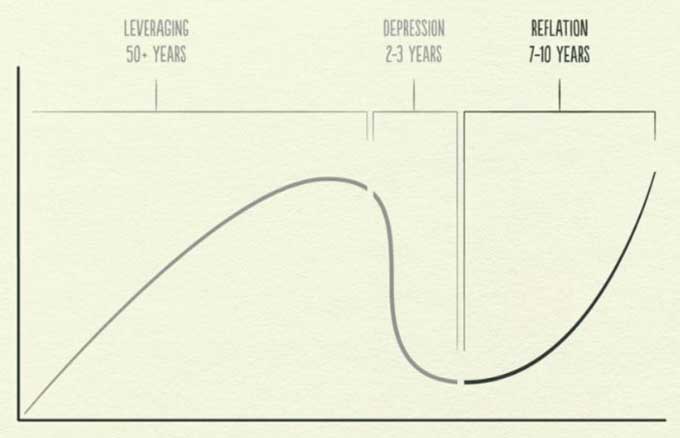
According to Dalio, the following template illustrates in detail the beginning and end of each economic cycle.
Graph: The Economic Cycle (based on the correlation between Productivity, Debt, and Growth)

There are two main economic cycles, each containing three key periods:
-
Leveraging Period (Growth) – Duration: 50–80 years
-
Depression Period – Duration: 2–3 years
-
Reflation Period – Duration: 7–10 years
Graph: The Duration of Economic Cycles

US Historical Business Cycles
The following table presents the historical expansions and contractions of US businesses. The source is the NBER (US National Bureau of Economic Research).
Table: Historical expansions and contractions of US businesses BUSINESS CYCLE DATES CYCLE DURATION (MONTHS) Peak Trough Contraction Expansion Cycle Quarterly dates Peak Previous trough Trough from Peak from -- June 1857(II) October 1860(III) April 1865(I) June 1869(II) October 1873(III) March 1882(I) March 1887(II) July 1890(III) January 1893(I) December 1895(IV) June 1899(III) September 1902(IV) May 1907(II) January 1910(I) January 1913(I) August 1918(III) January 1920(I) May 1923(II) October 1926(III) August 1929(III) May 1937(II) February 1945(I) November 1948(IV) July 1953(II) August 1957(III) April 1960(II) December 1969(IV) November 1973(IV) January 1980(I) July 1981(III) July 1990(III) March 2001(I) December 2007 (IV) February 2020 December 1854 (IV) December 1858 (IV) June 1861 (III) December 1867 (I) December 1870 (IV) March 1879 (I) May 1885 (II) April 1888 (I) May 1891 (II) June 1894 (II) June 1897 (II) December 1900 (IV) August 1904 (III) June 1908 (II) January 1912 (IV) December 1914 (IV) March 1919 (I) July 1921 (III) July 1924 (III) November 1927 (IV) March 1933 (I) June 1938 (II) October 1945 (IV) October 1949 (IV) May 1954 (II) April 1958 (II) February 1961 (I) November 1970 (IV) March 1975 (I) July 1980 (III) November 1982 (IV) March 1991(I) November 2001 (IV) June 2009 (II) April 2020 -- 18 8 3 2 18 65 38 13 10 17 18 18 23 13 24 23 7 1 8 14 13 43 13 8 11 10 8 10 11 16 6 16 8 8 2 -- 30 22 46 18 34 36 22 27 20 18 24 21 33 19 12 44 10 22 27 21 50 80 37 45 39 24 106 36 58 12 92 120 73 128 -- 48 30 78 36 99 74 35 37 37 36 42 44 46 43 35 51 28 36 40 64 63 88 48 55 47 34 117 52 64 28 100 128 91 130 -- -- 40 54 50 52 101 60 40 30 35 42 39 56 32 36 67 17 40 41 34 93 93 45 56 49 32 116 47 74 18 108 128 81 146 AVERAGE (ALL CYCLES) Peak Previous trough Trough from Peak from 1854-2009 (33 cycles) 1854-1919 (16 cycles) 1919-1945 (6 cycles) 1945-2009 (11 cycles) 17.5 21.6 18.2 11.1 38.7 26.6 35.0 58.4 56.2 48.2 53.2 69.5 56.4 48.9 53.0 68.5 Source: NBER (US National Bureau of Economic Research)
are in parentheses
to
Trough
to
this peak
Previous
Trough
Previous
Peak
to
Trough
to
this peak
Previous
Trough
Previous
Peak
◘ Economic & Business Cycles
G.P. for TradingCenter.org (c)
L MORE LEARNING RESOURCES • COMPARE • TECHNICAL ANALYSIS • LEARNING
□ Forex Brokers Comparison
□ Expert Advisors (EAs)
□ Broker Reviews
□ Learning
• FUNDAMENTAL ANALYSIS
» Financial Ratios
» Money Supply & Liquidity
» Dow Theory & Strategy
» P/E, PEG, and Shiller P/E
» Risk-Adjusted Portfolio Ratios
» Commitments of Traders
» Technical Analysis Guide
» Trading Chart Patterns
» Harmonic Price Patterns
» Forex Technical Analysis
» Fibonacci Primes Sequence
» Naked Charts & Price Zones
» RSI Precision
» PriceMomentum Chart
» TD Sequential
» Key Technical Indicators
» ΔMP and Σ(ΔMP) Indicators
» Wyckoff Method
» Forex Pairs
» Trading Books
» Trading Tips
» Philosophy Section
