
 Global Markets and Nasdaq Composite Report -A Correction is healthier than a bubble
Recently, US stock markets—along with other major markets around the world—have faced significant selling pressure. Many analysts believe equities are overpriced, while others argue that US economic growth and corporate earnings justify even higher market valuations. In the bond market, US bonds are also under pressure. As hedge fund manager Leon Cooperman put it: “Investors buying bonds right now are playing with dynamite.”
In this analysis, we will look at what could happen next in global markets, with a focus on the Nasdaq Composite. Whatever the conclusion, don’t panic—if you decide to exit the market, you will have the chance to do so properly.
Cash Will Be King Again – It Always Is in the End
In one of our past analyses, we noted that the current bullish cycle in global capital markets was nearing its end. This forecast was based on both fundamental and technical analysis. We also said, “Cash will be king again; it always becomes king at the end.” For some investors, this prediction has worked in their favor—while for many others, unfortunately, it has not.
What Happens Next for the US and Global Equity Markets
To assess the current market situation and forecast what comes next, we first need to consider some key points about US stock markets:
(a) Reasons for the Stock Markets to Rise (↑)
√ The US economy is enjoying steady growth and is stronger than at any time since 2008.
√ Unemployment is falling and incomes are rising.
√ Corporate earnings are strong, and according to some analysts—such as Goldman Sachs’ David Kostin—many investment opportunities remain in the market.
🔗 Link: » Goldman’s Recent Report on S&P
√ There is still excessive liquidity in the market, driven by the almost-zero interest rates
(b) Reasons for the Stock Markets to Rise (↓)
X Institutional and individual investors have enjoyed exceptionally high returns since 2009.
X US interest rates are close to entering a rising cycle, expected to begin in early 2015.
X The Eurozone faces long-term growth challenges, which directly impact exports from US and Asian companies.
X The US dollar is strengthening, which is typically bad news for US equities. European Central Bank President Mario Draghi recently said: “Fiscal action is needed to kickstart the European economy, particularly from those countries that can afford to do so,” then added, “You decide which country this sentence applies to.”
X Political instability is growing in several regions, including Eastern Europe and the Middle East, adding significant systemic risk to all global equity markets.
X The downward trend in energy prices indirectly signals weaker future demand from major energy-consuming countries.
X Many observers are warning about a possible technology bubble—similar to 1999—due to the extreme valuations of some start-ups.
Technical Analysis on Nasdaq Composite Using MACD and SMA
To forecast the Nasdaq Composite’s direction in the coming months, we use MACD and a Simple Moving Average (SMA).
□ MACD: Standard settings (12,26,9)
□ SMA: 34 periods (Note: There is no fixed rule for the number of SMA periods—always use what fits best through trial and error.)
Technical Analysis Conclusions:
-
The MACD line has already met its signal line, making the coming weeks crucial. A break below the signal line would be considered a strong sell signal.
-
The MACD lines show no divergences (a neutral signal, indicating a possible continuation of the trend).
-
However, the MACD histogram shows a strong divergence (a sell signal), as seen in the chart.
-
The Nasdaq Composite is currently far above its SMA (34) price level, which may indicate an overbought market.
-
The first target level in a declining market is where the index meets the SMA (34).
Statistics – Forming the Nasdaq Composite Historic Pattern
Below are statistical findings on the Nasdaq bullish pattern over the past 25 years:
Forming the Nasdaq Composite Historic Pattern
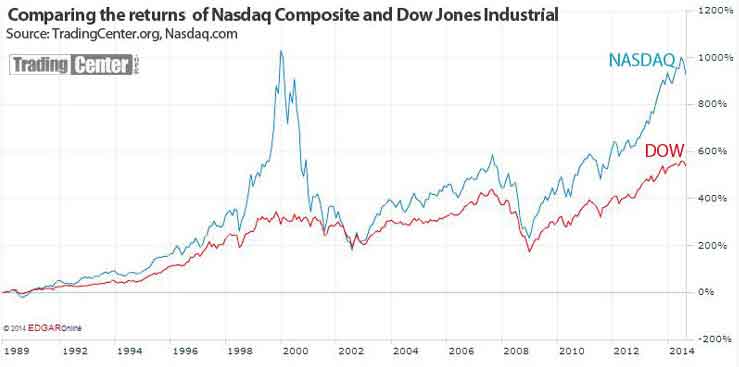
According to TradingCenter.org’s research of the last 25 years, US and global markets tend to follow a bullish cycle lasting about 5–6 years. Here are the three bull markets of the past 25 years: 1st Bull Market: 9-DECEMBER 1994 / 10-MARCH 2000 Started: DECEMBER 1994: Low 710.94 (close 719.05) Ended:10-MARCH 2000: High 5.132.52 (close 5,048.62) Total Return (High-Low): 4,329.57 Points Total Return (%): 608.99% Duration: 1,325 Trading Days (or 5 years and 3 months) 2nd Bull Market: 10-OCTOBER-2002 / 31-OCTOBER 2007 Started:10 OCTOBER 2002: Low 1,108.49 (close 1,165.37) Ended:31 OCTOBER 2007: High 2,861.51 (close 2,859.12) Total Return (High-Low): 1,693.75 Points Total Return (%): 152.8% Duration: 1,273 Trading Days (or 5 years and 1 month) 3rd Bull Market: 9 MARCH 2009 The 3D Bull market started on March 9, 2009. Started: 9 MARCH 2009: Low 1,265.50 (close 1,268.64) Ends: … 2014
The above statistics were part of an analysis by TradingCenter.org (April 2013).
Chart: Nasdaq Composite Returns vs. Dow Industrial Returns
Looking Ahead: What the Next Months Hold for Global Markets
It looks like a correction in the US and global equity markets is unavoidable. This might seem like bad news for some investors, but it’s better to have a normal market correction now than to see a new stock-market bubble form, which could push the global economy into dangerous territory like it did in 2008. A strong correction lasting 6 to 9 months could safely guide global markets into a new long-term bullish phase lasting many years. There are good reasons to expect growth over the next decade, driven by technological advances like the mobile economy and 3D printing. However, in capital markets, growth can’t—and shouldn’t—happen without some corrections along the way.
■ George Protonotarios, Financial Analyst
for TradingCenter.org, (October 10th, 2014)
L MORE RESOURCES • COMPARE • GLOBAL MARKETS • FOREX PAIRS • OTHER ASSETS
□ Forex Brokers Comparison
□ Expert Advisors (EAs)
□ Fx Seasonality Calendar
□ TCI Forex Trade Signals
□ Reviews
» Forex Market
» Equity Trading
» Commodities
» EURUSD
» GBPUSD
» USDJPY
» USDCHF
» USDCAD
» AUDUSD
» Historical Perspective on Gold Prices
» Crude Oil Trading
