
The Struggle of Humans with Change
Humankind has always struggled with change, and it is even harder to grasp how much the macroeconomic landscape has shifted in the past few years. The unseen economic impact of the pandemic led central banks to cut interest rates and increase market liquidity to record levels. In this environment of extreme liquidity and near-zero risk-free returns, the rally in equities and other hard assets was both reasonable and expected. Equally reasonable and expected was the recent market correction. It’s important to remember that from the March 2020 lows, equities rose over 100% without a significant pullback.

The Macroeconomic Landscape
Currently, economic growth is strong worldwide. In the first two quarters of 2021, US GDP grew over 6%, while growth in the European Union has been more modest. Unemployment remains high but is improving, with the US around 5% and the EU near 7%. However, the main concern for Western economies is not growth or unemployment—it is inflation.
Inflation, Money Supply, and Money Velocity
Historically, high money supply combined with low interest rates has driven higher inflation. Inflation is essentially the product of money supply and money velocity (supply × velocity). Money velocity measures how often the average unit of currency is used to buy goods and services over a given period. In simple terms, it shows how quickly money circulates in the economy. As the pandemic eases and money velocity rises, inflation begins to increase. Rising fuel prices have made the situation worse. In September, annualized inflation in the Eurozone hit 3.4%, even before the fuel price surge. Data suggests inflation in the coming months could reach record levels.
Higher inflation could accelerate tapering and trigger significant interest rate increases. Financial markets have already priced in:
-
FED tapering in November 2022 (latest FED forecast)
-
Interest rate hikes at the end of 2022 (based on current FED watch tools)
The fuel price rally threatens serious fiscal and monetary challenges. So far, there are no signs that either the US or the Eurozone intends to change monetary policies.

Fundamental Landscape of American Markets
According to early October 2021 data:
- The Dow Jones Industrial Average P/E is 23.1, and the dividend yield is 1.87%
- The S&P500 P/E is 30.0, and the dividend yield is 1.38%
- The Nasdaq100 P/E is 34.1, and the dividend yield is 0.72%
Looking at P/Es from a historical perspective, American stock markets appear about 30% more expensive than their long-term average. However, given the strong GDP growth expected for 2021–2022 and near-zero interest rates, these valuations are not overly high. The Dow Jones P/E of 23 is reasonable in the current macroeconomic context, and the 1.87% dividend yield is attractive. A greater concern for equity markets may be the impact of rising fuel prices on corporate profitability.
🔗 More: » Valuing the Stock Market with P/E, PEG, and Shiller P/E
Another issue is the bankruptcy of Chinese property giant Evergrande. While the $300 billion bankruptcy is significant, it is not catastrophic. The main worry is a potential domino effect on international markets. Much will depend on how the unpredictable Chinese government responds.
Technical Analysis of American Markets
Since the March 2020 lows, equity markets have surged significantly without a major correction. For example, the Nasdaq 100 has risen about 130%, with the largest pullback around 14%. Historically, such rapid gains without corrections often lead to sharp downward movements like the one we are seeing now.
The first target for US markets is the 200-day moving average (SMA200), and it is possible that prices could fall up to 10% below this level. The market is likely to present significant opportunities for those who have maintained substantial cash liquidity. Technical analysis suggests the correction will continue but within reasonable limits.
Chart: Daily (D1) Nasdaq 100 with basic technical analysis
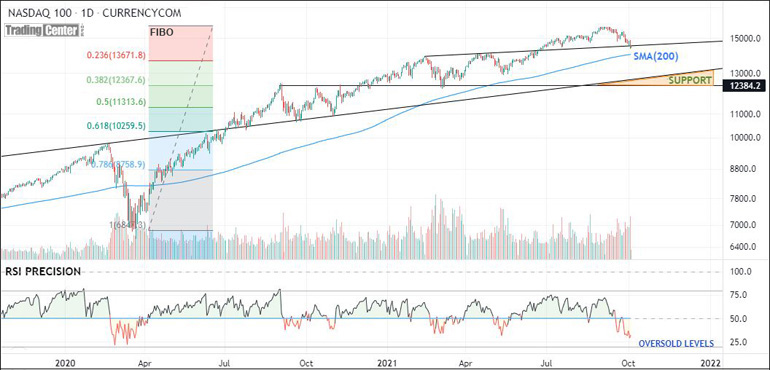
In the chart above, we can see the Nasdaq 100 along with its 200-day moving average (blue), Fibonacci retracement on the left, and RSI Precision below. RSI Precision appears to be approaching oversold levels but still has room to move lower. (More about RSI Precision)
Conclusions
Economic growth and the zero-interest-rate environment remain supportive for equities, and fundamentals are not overly expensive. However, rising fuel prices and the potential domino effect from the Chinese Evergrande crisis pose risks to the macro-bullish trend. From a technical analysis perspective, the outlook is bearish. In the coming months, the market is likely to offer significant opportunities for those holding substantial cash liquidity.
■ The Stock Market in 2021-2022
Giorgos Protonotarios, Financial Analyst
for TradingCenter.org (c)
5th of October 2021
L MORE TUTORIALS • GENERAL GUIDES • TECHNICAL ANALYSIS
□ Equity Trading
» TD Sequential
» Wyckoff's Method
• FUNDAMENTAL ANALYSIS
» Money Supply & Liquidity
» Dow Theory & Strategy
» P/E, PEG, and Shiller P/E
» Warren Buffett’s Method
» Zweig Breadth Thrust Signal
» Benner’s Cycle
» Stock Market Formula
» MOVE Volatility Index

