The Cyclicality of Financial Markets and Benner’s Cycle
Benner’s Cycle is a simple model that predicts the ups and downs of the stock market based on a repetitive market cycle of 18/16/20 years. As briefly shown below using historical data, the model is reliable at the beginning of each market cycle, and completely unreliable at the end of the cycle. As concerns market tops and mid-cycle tops, the model is sometimes accurate, and sometimes not.
Decoding the Cyclicality of Financial Markets
Financial markets tend to follow specific cycles. Over time, these cycles create recognizable patterns. Spotting these patterns can help improve investment decisions. Knowing when a market cycle may begin and end can be very useful for investors.
✅ Market cycles follow economic cycles, which are shaped by liquidity, inflation, and interest rates.
✅ A market cycle has two or four distinct phases. Each phase reflects specific trends that emerge during different economic conditions.
✅ Generally, a market cycle can range from six months to many years, or even decades.
Mature vs. Emerging Markets: What Sets Them Apart
Before moving forward, it is useful to examine the main differences between mature and emerging markets.
Volatility and the length of market cycles are the two main elements that set each financial market apart. As shown in the following chart, mature markets follow longer cycles, are less volatile, and offer lower risk/return ratios than emerging markets.
Graph: Analyzing Differences Between Mature and Emerging Markets
Source: The chart is from my latest book, “A Game of Chess in the Global Markets”
Example
For example, consider the cryptocurrency and commodity markets. The cryptocurrency market follows a short 4-year cycle, while commodity markets follow much longer cycles. At the same time, the cryptocurrency market is much riskier and offers considerably higher returns than any commodity asset. Thus, if we were to place these two markets on the chart above, the cryptocurrency market would be on the left (emerging market) and the commodity market on the right (mature market).
The Powerful Role of Institutional Investors in Shaping Markets
Among other things, the level of participation of large institutional investors plays a significant role here. The stronger the presence of large institutional investors in a financial market, the lower the volatility and the greater the cyclicality. The increasing presence of institutional investors can transform market behavior.
Benner’s Cycle Theory
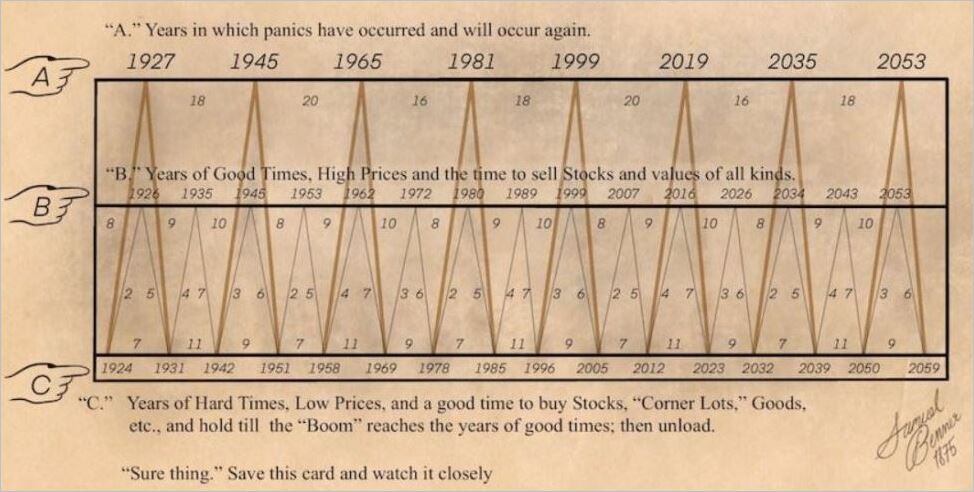
Published in 1872 on a business card, Benner’s Cycle theory is designed to predict the market’s highs and lows. Later, in 1875, Samuel Benner published a book with commodity price forecasts for the period 1876 -1904. In the book “Benner’s Prophecies: Future Ups and Downs in Prices”, he tried to explain historical market changes and the high degree of cyclicality. Benner mentioned three commodity cycles:
An 11-year pattern of corn and pig prices, with peaks occurring every 5-6 years
11-year peaks of cotton prices
A 27-year cycle in the price of pig iron
Explaining Benner’s Cycle Model
On Benner’s Cycle chart, four key events make up a complete market cycle:
1️⃣ The start of a market cycle
2️⃣ The top of the market cycle
3️⃣ The bottom of the market cycle, and the start of a mid-cycle
4️⃣ The top of the mid-cycle
👉 Note: After the bottom of the mid-cycle, a new market cycle starts (1️⃣).
Chart: Benner’s Cycle chart
👉 Note: The above chart shows the years of euphoria, the hard years, and the years of panic.
Market's Periodicity
These are some basic assumptions based on the chart above:
CYCLE BEGINNING: 18/16/20 years
Starting in 1924, a new cycle begins every 18/16/20 years.
CYCLE TOP: 18/20/16 years
Starting in 1927, a new market cycle top occurs every 18/20/16 years.
CYCLE BOTTOM: 20/18/16 years
Starting in 1931, a new market cycle bottom occurs every 20/18/16 years.
MID-CYCLE TOP: 18/19/17 years
Starting in 1935, a new mid-cycle top occurs every 18/19/17 years.
Empirical Validation of Benner’s Cycle Model with Historical Market Data
Some analysts argue that Benner’s cycle successfully predicted almost all the tops and bottoms of the American stock market of the past century. Others claim that there is neither logic nor justification behind the Benner Cycle; thus, it can’t be seen as a reliable theory.
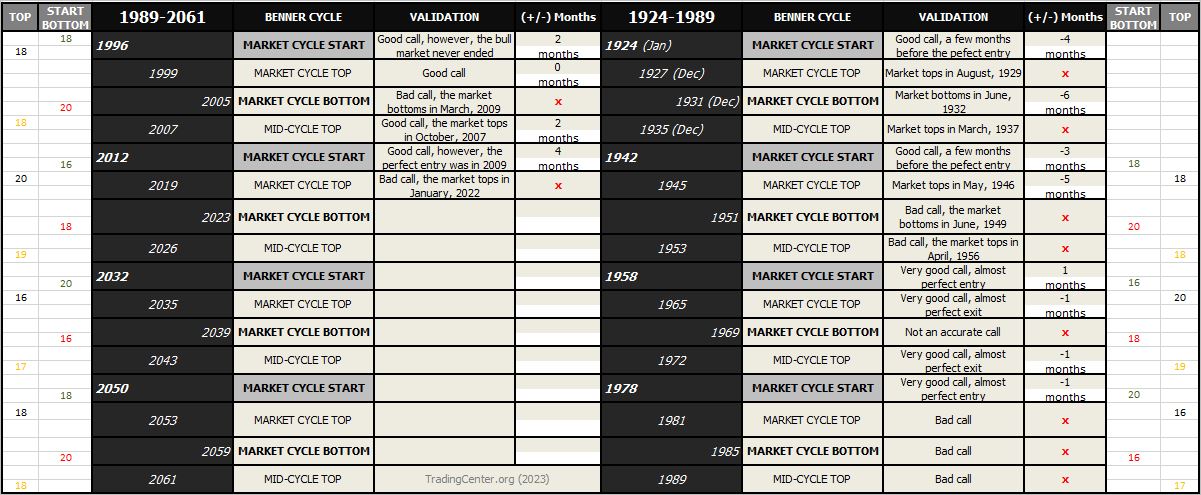
However, data is more important than opinions, and the best way to validate Benner’s forecasts is by using historical backtesting. The following chart shows all of Benner’s forecasts since 1924 and how they have been validated.
👉 Note: Each market cycle starts in January, while all the tops/bottoms are calculated based on December.
Chart: Validating Benner’s Cycle forecasts since the beginning
Conclusions
Here are some key conclusions regarding Benner’s Cycle model:
Market Cycle Beginning
Benner’s Cycle appears to be very successful at predicting the start of each cycle. Note that every entry since 1924 has been profitable.
Market Cycle Top
The model was less successful at predicting market cycle tops, with 3 accurate calls and 3 inaccurate ones.
Market Cycle Bottom
The model was not successful in predicting market cycle lows, with only 1 accurate call and 4 inaccurate ones.
Mid-Cycle Top
The model wasn’t very successful at predicting mid-cycle tops, as there were 2 good and 3 bad calls.
Overall, Benner’s Cycle is very reliable at the beginning of each market cycle and completely unreliable at the end of each market cycle. As regards market tops and mid-cycle tops, the model is sometimes accurate and sometimes not.
Other Cyclical Economic Market Theories
There are quite a few other market theories that aim to explain the cyclicality of financial markets:
Ralph Nelson Elliott supported that the stock market follows a recognizable pattern consisting of two phases: an impulsive phase and a corrective phase.
The impulsive phase is composed of five sub-waves (1, 2, 3, 4, 5) and moves in the same direction as the main trend
The corrective phase comprises three sub-waves (a, b, c)
William Delbert Gann claimed he had discovered a repeating pattern of time and price that allowed him to predict market tops and bottoms. Collective behavior creates cycles through time, and that is what Mr. Gann called the “Law of Vibration”.
According to this theory, human behavior creates predictable vibrations in the whole market. Gann used circles, triangles, and squares in his work.
The square of nine is a trading method that squares price and time. The first square is completed by using the number 9. Each cell in Gann’s square of nine is a point of vibration.
The Capital Cycle Book -Examining Stock Market Cycles Since 1896
The following analysis is part of my latest book, ‘The Capital Cycle,’ which examines historical trends and patterns in equities, Forex currencies, cryptocurrencies, and gold.
Cyclicality is a defining feature of the global economy and of every financial market worldwide. This phenomenon can be attributed to the cyclical nature of human behavior, which influences consumption, production, and investment. Historically, the economy follows secular cycles lasting approximately 35 to 45 years, alongside shorter business cycles averaging 6.2 years. Equity markets mirror this rhythm, displaying long-term secular cycles that align closely with macroeconomic trends and span roughly 35 to 43 years, while also exhibiting mid-term cycles lasting about 3.2 to 4.5 years (on average).
TradingCenter offers key information and tools for learning and trading in global financial markets. It helps investors enhance their skills and gain a deeper understanding of the core mechanics of trading.
☑ Our philosophy: "Think like a long-term investor and execute like a short-term trader"