
 Cyclicality is a defining feature of the global economy and of every financial market worldwide. This phenomenon can be attributed to the cyclical nature of human behavior, which influences consumption, production, and investment. Historically, the economy follows secular cycles lasting approximately 35 to 45 years, alongside shorter business cycles averaging 6.2 years. Equity markets mirror this rhythm, displaying long-term secular cycles that align closely with macroeconomic trends and span roughly 35 to 43 years, while also exhibiting mid-term cycles lasting about 3.2 to 4.5 years (on average). The following analysis, part of my latest book ‘The Capital Cycle’, examines these historical trends and patterns.
(i) The Interplay of Economic Cycles and Secular Stock Market Cycles
Economies move through secular cycles that unfold over several decades, driven primarily by debt dynamics, political forces, and technological innovation. An economic cycle represents the period between two major recessions (GDP troughs), forming a recurring pattern of expansion followed by contraction.
Several economic theories have sought to measure the duration of the economic cycle. The table below summarizes some of these theories.
Table: Economic Theories & Cycles
|
ECONOMIC CYCLES |
DURATION |
BASIS |
IDENTIFIED |
|
45-60 Years |
Technological Waves |
1926 |
|
35-43 Years |
Economy/GDP |
(-) |
|
15-25 Years |
Demographic/Infrastructural |
1930 |
|
7-11 Years |
Fixed Capital/Debt |
1862 |
|
6.58 Years |
Economic/Monetary |
(-) |
|
6.21 Years |
Economy/GDP |
(-) |
|
4.87 Years |
Economy/GDP |
(-) |
|
3.33 Years |
Informative/Inventory |
1920s |
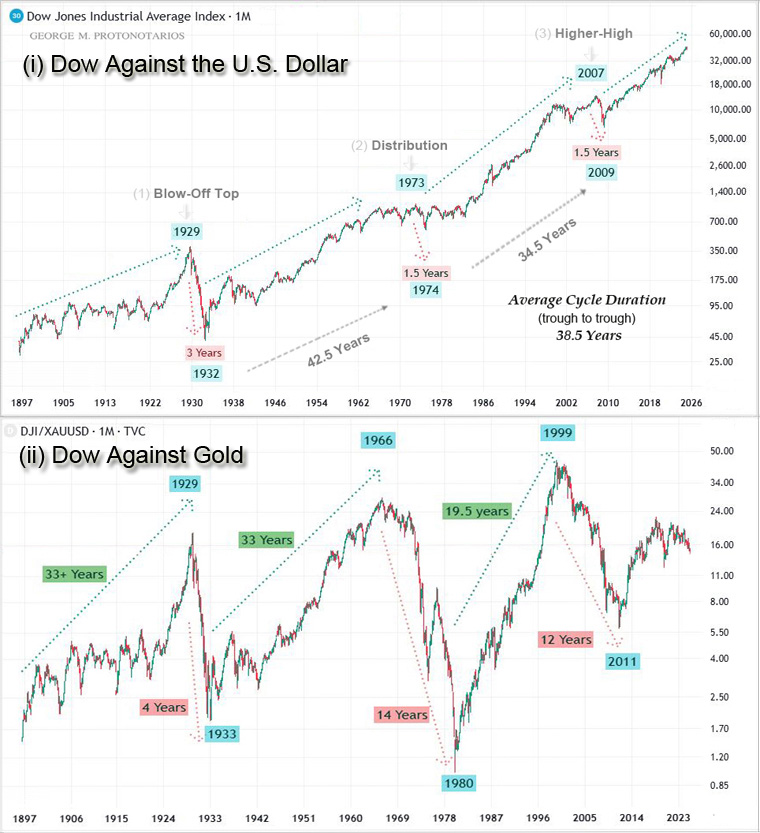
By examining major historical events, such as the financial crisis of 1929-1932, the energy crisis of the early 1970s, and the financial crisis of 2007-2009, we can identify two completed secular economic cycles (measured from trough to trough):
- 1932-1974, lasting 42.5 years
- 1974-2009, lasting 34.5 years
Historical troughs between 1932-1974 (42.5 years) and 1974-2009 (34.5 years) indicate an average secular duration of 38.5 years. These long economic waves correspond to major equity market bottoms in 1932, 1974, and 2009, confirming that stock market secular cycles mirror these secular rhythms.
The following figures represent the average macro-cycle durations across major asset classes:
- Dow Jones Industrial / S&P 500: 37.5-38.5 years
- Gold: 29.5 years
- NASDAQ / DAX: 28.0-28.5 years
- US Dollar Index: 15 years
- Cryptocurrencies: 4 years
Typical Structure of the Stock Market Cycle
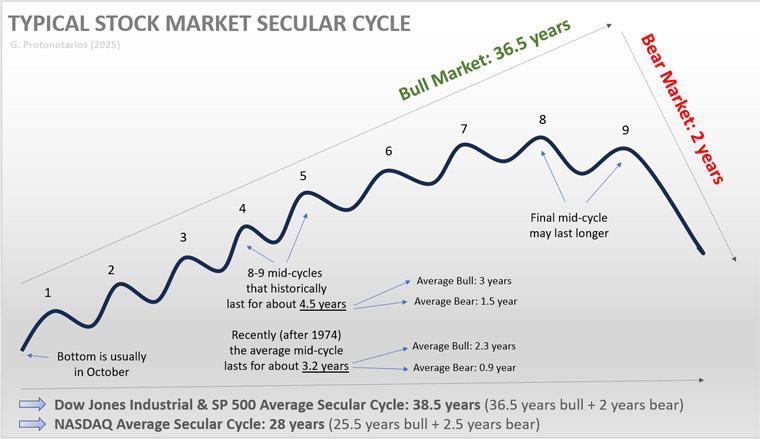
While the length of each equity market cycle may vary, a common structure across different secular cycles can be identified. Based on the duration and features of past market cycles, the graph below shows the typical structure of the Dow Jones Industrial Average cycle, which closely resembles that of the S&P 500. Note that the NASDAQ and DAX historically exhibit a different market structure.
Graph: Typical Structure of the Stock Market Secular Cycle
Important Points Regarding the Equity Secular Cycles
Here are some key points to keep in mind about equity secular cycles.
- The average Dow Jones and S&P 500 secular cycle lasts 38.5 years, consisting of a 36.5-year bull market and a 2-year bear market
- Dow Jones and S&P 500 secular cycles share similar characteristics
- The Nasdaq secular cycle is shorter (28 years) and more closely aligns with the German DAX (28.5 years)
- Dow Jones and S&P 500 secular cycles typically include 8-9 completed mid-cycles:
- Historically (1896-2024), a typical mid-cycle lasts about 4.5 years, with a bull phase of 3 years and a corrective phase of 1.5 years
- More recently (1974-2024), a typical mid-cycle lasts about 3.2 years, with a bull phase of 2.3 years and a corrective phase of 0.9 years
- Each mid-cycle may include several tactical cycles, typically lasting 2-6 months
- Mid-cycles tend to peak in the first half of the year, especially in January
- Mid-cycles tend to bottom in the second half of the year, particularly in October and December
- Nasdaq ended a bear market 8 out of 19 times in October (an incredible statistic)
Exploring Dow Jones Industrial Historical Market Cycles
Structurally, the three Dow Jones secular cycles were similar; however, there were differences in the three market cycle tops:
- The 1929 market cycle top was a classic blow-off top after a parabolic bull run (during 1922-1929)
- The 1966-1973 market cycle top was a double-top formation
- The 2007 market cycle top occurred after a higher high on the chart and differs from the previous two market tops
The following chart highlights the Dow Jones Industrial Average's secular cycles relative to the U.S. dollar and gold, focusing on macro tops and bottoms.
Chart: The Dow Jones Industrial Market Cycles (1897–2025) in Relation to (i) the U.S. Dollar and (ii) Gold
(ii) The Business Cycle and Mid-Cycles in the Stock Market
The business cycle is generally considered synonymous with the economic cycle. However, there are various approaches to the concept. The economy appears to experience three distinct types of cycles:
- Long Secular Cycle, lasting 35-45 years
- Business Cycle, lasting 2-10 years
- Tactical Cycle, lasting 1-12 months
Like the secular economic cycle, the business cycle refers to the period between two consecutive economic recessions (troughs).
When measuring the length of the business cycle, the focus is on the U.S., since the American economy makes up over 25% of global GDP and U.S. equity markets represent more than 40% of global equity market capitalization. From 1945 to 2020, U.S. business cycles averaged 6.21 years, closely aligning with the Federal Funds Rate cycle of 6.58 years (analyzed below).
- The average duration of the secular economic cycle (38.5 years) is equivalent to roughly six business cycles (6 × 6.21 = 37.26)
According to the data presented in the book, secular economic cycles appear to have shortened over time, a general trend that may be attributed to several factors, including increasing economic globalization, accelerated technological progress, and the expanding influence of the speculative financial sector. However, the business cycle has tended to last longer after 1945 than before. Taken together, these two findings suggest that modern secular economic cycles are shorter in duration and comprise fewer but longer business cycles.
The Equity Markets Mid-Cycles
Within each business cycle, equities experience mid-cycles. Equities typically outperform during the expansion phase of the business cycle and underperform during recessions: (1) Early Growth: +20% annually, (2) Mid Growth: +14%, (3) Late Growth: +5%, and (4) Pre-Recession / Recession: -15%.
Examining Mid-Cycles Across Dow Jones Industrial Market Cycles
Based on the period 1932-2009, each completed DJIA secular cycle consists of 9 mid-trends (mid-cycles).
Historically: (1896-2025)
- Each mid-trend typically lasts 4.5 years
- The average uptrend lasts 3 years; the average downtrend lasts 1.5 years
Recently: (1974-2025)
- Each mid-trend typically lasts 3.2 years
- The average uptrend lasts 2.3 years; the average downtrend lasts 0.9 years
The Dow Jones Industrial Average’s average mid-cycle duration of 3.2 years suggests that roughly two major stock market trends unfold within each business cycle (2 × 3.2 = 6.4).
- Statistically, for every business cycle that averaged 6.21 years, there were about two stock market mid-cycles that averaged 3.2 years
U.S. Federal Funds Rate Cycles
The FEDFUNDS rate is the interest rate charged on overnight lending between commercial banks, influenced by the FED through open market operations. Based on monthly data from the Federal Reserve Bank of St. Louis, the table below shows the FEDFUNDS cycles from 1954 to 2025.
Table: FEDFUNDS rate completed cycles (1954 to 2025)
|
A/A |
PERIOD |
DURATION (years) |
PEAK |
DATE |
INCREASING (years) |
DECLINING (years) |
|
1 |
7/1954-5/1958 |
3.83 |
3.50% |
Oct-57 |
3.25 |
0.58 |
|
2 |
5/1958-7/1961 |
3.17 |
4.00% |
Nov-59 |
1.50 |
1.67 |
|
3 |
7/1961-7/1967 |
6.00 |
5.76% |
Nov-66 |
5.33 |
0.67 |
|
4 |
7/1967-2/1972 |
4.58 |
9.19% |
Aug-69 |
2.08 |
2.50 |
|
5 |
2/1972-1/1977 |
4.92 |
12.92% |
Jul-74 |
2.42 |
2.50 |
|
6 |
1/1977-10/1986 |
9.75 |
19.10% |
Jun-81 |
4.42 |
5.33 |
|
7 |
10/1986-12/1992 |
6.17 |
9.85% |
Mar-89 |
2.42 |
3.75 |
|
8 |
12/1992-12/2003 |
11.00 |
6.54% |
Jul-00 |
7.58 |
3.42 |
|
9 |
12/2003-2/2014 |
10.17 |
5.26% |
Mar-07 |
3.25 |
6.92 |
|
10 |
2/2014-4/2020 |
6.17 |
2.42% |
Apr-19 |
5.17 |
1.00 |
|
|
Average (1954-2025) |
6.58 |
7.85% |
|
3.74 |
2.83 |
For the period 1954-2025, the average duration of the FEDFUNDS rate cycle is 6.58 years. Notably, this duration is very close to the 6.2-year average of the business cycle.
The Capital Cycle Book
The information above is excerpted from The Capital Cycle, published in late 2025. The book is organized into five chapters:
- Chapter 1 outlines the business cycle and liquidity dynamics, examining economic models and relating interest rates, money supply, and oil price cycles to broader market trends.
- Chapter 2 explores stock market structure, mid-cycles, and seasonality across Dow Jones, S&P 500, NASDAQ, and DAX, linking corporate earnings with equity performance.
- Chapter 3 examines the Foreign Exchange market, analyzing the macro and seasonal cycles of the US Dollar Index and eight pairs (EUR/USD, GBP/USD, USDJPY, USD/CHF, USD/CAD, AUD/USD, NZD/USD, EUR/GBP), emphasizing how central bank policies influence exchange rates.
- Chapter 4 focuses on cryptocurrencies and gold, tracing Bitcoin and Ethereum’s four-year cycles alongside gold’s long-term and seasonal patterns.
- Chapter 5 presents the analytical framework of key cyclical theories (Dow Theory, Elliott Wave Principle, Wyckoff Method, W.D. Gann, and Benner’s Cycle) -each offering a distinct perspective on market rhythm and investor psychology.
Links
🔗 You can purchase the ePub edition of the book on Amazon: » https://www.amazon.com/dp/B0FYNLQYTM
🔗 A PDF edition of the book is available for purchase on PayHip: » https://payhip.com/b/L1ouf
■ Exploring Economic and Stock Market Secular Cycles Since 1896 -From My Latest Work, ‘The Capital Cycle’
Giorgos Protonotarios, Investment Analyst
for TradingCenter.org (c), November 6th, 2025
L MORE TUTORIALS • GENERAL GUIDES » Learning • TUTORIALS • OTHER RESOURCES
» Equity Trading
» Training
» Fundamental Analysis
» Rating Formulas
» RSI Precision
» Trading Books
» Forex Brokers
