
 Financial markets are highly cyclical, and this can be attributed to multiple reasons - the rhythmic expansion and contraction of the economy, the cyclicality of investment flows, and our own human nature. Periods of excessive fear and greed among retail investors push markets to form tops and bottoms, which then correct, reinforcing the cyclical nature of capital markets. This topic is examined in greater depth in my latest book, ‘The Capital Cycle.’
As cyclical analysis plays a critical role in understanding market structure, TradingCenter.org has, over the years, presented a broad range of methodologies, including the Wyckoff Accumulation/Distribution, Elliott Wave Principle, T.D. Sequential, and Harmonic Patterns. This time, we turn to another influential framework in cycle analysis: J.M. Hurst’s Cycle Model.
What is J.M. Hurst’s Nominal Cyclical Model (NMC)
Developed in the 1960s, Hurst's Cycle Model is a cyclical analysis framework that aims to identify structure in financial markets, enabling a degree of relative predictability. The basis of this concept is the recognition of repeating cycles following a hierarchical, wave-like structure.
Key Takeaways
- The prices of financial assets move in cyclical rhythms, while market movements are the result of multiple overlapping cycles of different durations.
- Market prices are structured in cycles nested within larger cycles, and each cycle includes an upward and a downward phase.
- Market cycles are continuous natural rhythms lasting 365 days a year. In Hurst’s original work, the length of each cycle (e.g., 40 days) was measured in calendar days, not trading days.
- The Nominal Cyclical Model introduced several key concepts in cyclical analysis, including (i) Harmonicity, (ii) Synchronicity, (iii) Summation, and (iv) Left/Right translation (cycle peak positioning).
- Hurst’s analytical framework provides a probabilistic edge rooted in timing. This means his analysis is not about forecasting reversals at exact price levels, but about identifying when price trends are most vulnerable to reversal.
- The Nominal Cyclical Model is basically applied to daily (D1) and weekly (W1) charts.

Exploring the 11 Cycles of the Hurst Model
Hurst argued that market prices do not move randomly; instead, they move according to specific time cycles. Based on this assumption and extensive research in the stock market, he identified 11 cycles for assessing the markets, ranging from 5 days to 18 years. These cycles are referred to as Hurst’s Nominal Model (NMC).
Key Cycles in Hurst’s Nominal Model
The most common market cycles are the 20-day, 40-day, 80-day, 18-month, and 4-year cycles. Each cycle is roughly twice as long as the previous one, and all of these market cycles can operate simultaneously.
- Short-Term: 5-day, 10-day, and 20-day
- Intermediate: 40-day, 80-day, 20-week, and 40-week
- Longer-Term: 18-month, 9-year, and 18-year
The above cycles are not perfectly even and vary according to their phase and overall length. Furthermore, these cycles are harmonically related, meaning that shorter cycles are structured components of longer ones. A 10-day cycle can be part of a 20-day cycle, which itself can be part of a 40-day cycle. According to Hurst, identifying the interactions between market cycles can lead to an understanding of key market turning points. The following table presents the full range of Hurst’s cycles along with their length in days.
Table: The Full Range of Hurst’s Nominal Cycle Model
|
Nominal Cycle |
Average length |
Average Length in Days |
|
5-day cycle |
4.3 days |
4.3 days |
|
10-day cycle |
8.5 days |
8.5 days |
|
20-day cycle |
17 days |
17 days |
|
40-day cycle |
34.1 days |
34.1 days |
|
80-day cycle |
68.2 days |
68.2 days |
|
20-week cycle |
19.48 weeks |
136.4 days |
|
40-week cycle |
38.97 weeks |
272.8 days |
|
18-month cycle |
17.93 months |
545.6 days |
|
54-month cycle |
53.77 months |
1636.8 days |
|
9-year cycle |
8.96 years |
3273.6 days |
|
18-year cycle |
17.93 years |
6547.2 days |
Source: J.M. Hurst
The Concept of ‘Summation’
Hurst’s cyclical analysis incorporates the principle of summation. This means that multiple market cycles simultaneously affect price, such that the price series is the sum of all active cycles. Some cycles may be rising while others are falling. The visible price movement at any moment is the net effect of these forces.
The Concept of ‘Translation’
Hurst’s analysis also introduced the concept of left and right chart translation. The process of ‘translation’ refers to the cycle’s peak, and more specifically to the position of a cycle’s peak within the analysis timeframe.
- In a left-translated cycle, the cycle’s peak occurs before the midpoint (a sign of weakness, observed in bear markets).
- In a right-translated cycle, the cycle’s peak occurs after the midpoint (a sign of strength, observed in bull markets).
Technical Analysis Methods & Tools Deriving from Hurst’s Nominal Cyclical Model
To identify market cycles from price data and filter out shorter-term price fluctuations, Hurst used detrending techniques such as centered moving averages. The following are key technical analysis tools and methods derived from Hurst’s Nominal Cyclical Model (NCM):
(1) Phasing Models
Phase models aim to identify the current phase of key market cycles and how much time has elapsed since the last price trough, to project the time remaining until the next one.
(2) FLD (Future Line of Demarcation) Models
FLD models project future price action by shifting the current market structure forward.
(3) Hurst Dominancy Envelope
The Dominancy Envelope is a tool for visualizing market cycles and their amplitude.
(4) Hurst Constant Envelope
The Constant Envelope is a tool for creating channels of constant width around a price average.
(5) MESA (Maximum Entropy Spectrum Analysis) Cycle Models
(6) Spectral Fourier Cycle Models
Example:
In the following Bitcoin weekly chart, an indicator based on Hurst's Cycle Model provides signals, which are confirmed by RSI Precision 3. The objective is to identify BTC reversal signals near macro bottoms.
- BTC/USD weekly (Index)
- Hurst Cycle Channel Oscillator v.1 by CryptoRhythms
- RSI Precision v.3 (Multisignal) by Giorgos Protonotarios
Chart: Spotting Macro Bottoms on the Weekly Bitcoin Index
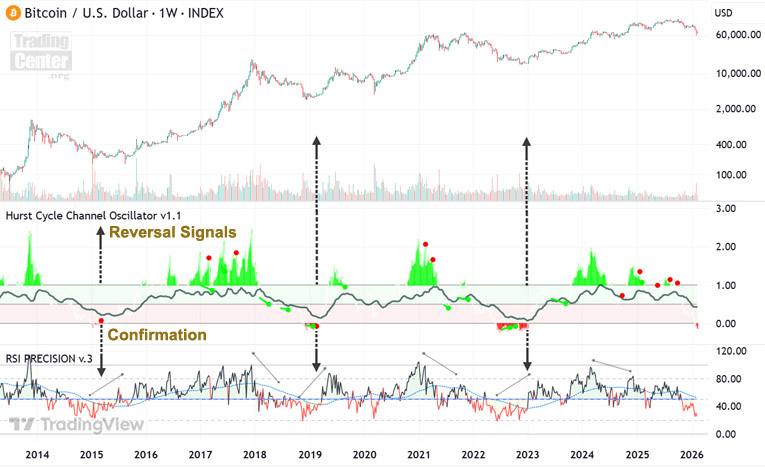
As seen in the chart above, three reversal signals (last red dots) are visible, each confirmed by RSI Precision. All three proved to be strong buying opportunities near Bitcoin's macro bottoms.

Conclusions - Hurst’s Nominal Cyclical Model
- According to the Nominal Model, market prices move in repeating cycles that can be calculated and projected forward.
- M. Hurst identified 11 market cycles ranging from 5 days to 18 years. These cycles are harmonically related in a structured way. Essentially, each shorter cycle is half the length of the next longer cycle.
- Multiple market cycles can simultaneously affect price, such that the price series is the sum of all active cycles. This is known as the principle of ‘Summation.’
- Hurst’s Nominal Cyclical Model is usually applied to daily (D1) and weekly (W1) charts, while Hurst's original work on cycle projections used calendar days, not trading days.
- Hurst’s analytical framework aims to provide a probabilistic edge rooted in timing, not in forecasting exact price levels of reversals.
- Hurst’s cyclical analysis remains influential among technical analysts who focus on market structure and timing forecasts.
■ Exploring the J.M. Hurst Nominal Cyclical Model (NMC)
Giorgos Protonotarios, Financial Analyst
for TradingCenter (c) - February 16th, 2026
🔗 Sources
- Hurst, J. M. (1970): The Profit Magic of Stock Transaction Timing
- Christopher Grafton: Mastering Hurst Cycle Analysis
- Fama, E. F. (1970): Efficient Capital Markets: A Review of Theory and Empirical Work - Journal of Finance
- Murphy, J. J. (1999): Technical Analysis of the Financial Markets - New York Institute of Finance
L MORE ON TECHNICAL ANALYSIS • COMPARE • TECHNICAL ANALYSIS • INDICATORS • CYCLICAL ANALYSIS • LEARNING
□ Forex Brokers Comparison
□ Expert Advisors (EAs)
□ Broker Reviews
□ Learning
» Technical Analysis Guide
» Trading Chart Patterns
» Naked Charts & Price Zones
» Forex Technical Analysis
» Fibonacci Primes Sequence
» Harmonic Price Patterns
» RSI Precision
» PriceMomentum Chart
» CVD Indicator
» Key Technical Indicators
» ΔMP and Σ(ΔMP) Indicators
» Wyckoff Method
» TD Sequential
» Hurst Nominal Cyclical Model
» Elliott Wave Principle
» Forex Pairs
» Trading Books
» Trading Tips
