

As anticipated in our Bitcoin analysis published at the end of 2025, the cryptocurrency market is currently experiencing a classic bear market phase. In particular, our analysis of November 18, 2025, stated: "Bitcoin has most likely topped for this cycle. While not guaranteed, it remains the most probable scenario. If the top is indeed behind us, historical patterns suggest the bear market may last roughly 12 months. In that case, an ABC decline could bottom out between October and November 2026. The expected low remains in the $45,000-50,000 zone". Note, that Bitcoin was trading at $92,600 at that time.
🔗 Read the 11/2025 analysis: https://tradingcenter.org/index.php/trade/cryptocurrency/387-bitcoin-cryptocurrency-analysis-2026
History shows that Bitcoin's deep bear market lasts about a year, and given that it started in October 2025, statistically we're just a few months away from the bottom. That said, there's a feeling that everything will happen faster in the current market cycle, so I expect the bottom to form somewhat earlier - perhaps even sometime this summer.
The Bitcoin Chart and RSI Precision
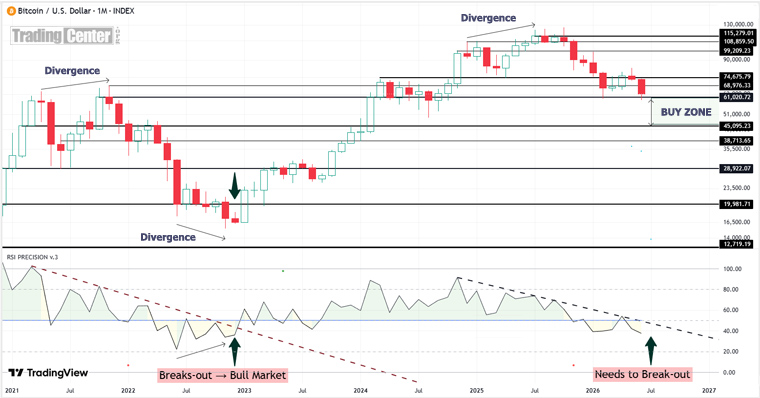
The following chart shows the Bitcoin Index on a monthly basis, alongside our proprietary indicator, RSI Precision. Notice how RSI Precision consistently signals divergences in Bitcoin's momentum slope ahead of every major trend shift - flagging bearish divergences before bear markets and bullish divergences before bull markets. Notably, no bullish divergence has yet emerged in the current bear market cycle.
Also observe how RSI Precision broke out of its negative slope with remarkable precision at the bear market bottom in late 2022 - exactly the kind of signal we are watching for again. When RSI Precision stages its next breakout, it will serve as a strong confirmation that Bitcoin's bottom is in.
Additionally, the chart highlights key support and resistance levels for Bitcoin. Based on our analysis, a primary Buy Zone is identified broadly between $45,000 and $60,000.
Chart: Monthly Bitcoin Index & RSI Precision
Below, the historical Bitcoin bottoms will be examined using a new technical indicator, the 'Speculators Curve'.
Introducing the New Indicator 'Speculators Curve' to the Web
In an effort to better capture the historical pattern of Bitcoin market bottoms, I created a new indicator called the 'Speculators Curve.' Essentially, this indicator is designed to accumulate intraday momentum and present it over a 200-day window. That means every point on the chart below is made up of the intraday momentum from the previous 200 days. One innovation introduced with the 'Speculators Curve' is the influence of daily trading volume on each individual data point. So, on days with heavy trading activity, the indicator reflects a stronger dynamic based on that day's market move. It's important to note that the indicator takes into account the daily volume in number of coins traded, not the dollar value of transactions. The reason for this is that Bitcoin can show a huge price swing over 200 days, which would make the dollar value of transactions appear unreasonably inflated or deflated. Coin volume, on the other hand, is a much more objective measure over a 6-7 month window when tracking changes in trading activity.
Speculators Curve characteristics:
- Accumulation of intraday momentum over 200 days
- Data used: daily closing price, high, low, and trading volume (not dollar value)
- Integration of daily volume dynamics into the representation of daily price swings
- Cyclical projections and timing estimates for future momentum transitions

'Speculators Curve' Indicator on Bitcoin/USD
Below, the new indicator is applied to Bitcoin/USD over the period 2013-2026. Three Bitcoin market cycles of roughly 4 years each are clearly visible.
- Interestingly, while there is alignment between Bitcoin price bottoms and tops and the Speculators Curve, at the peaks of the last two cycles (2021 and 2025) the Speculators Curve had already topped out several months earlier.
- Another interesting detail is that the peaks and troughs of the Speculators Curve smooth out over time. This makes perfect sense as Bitcoin, as a financial asset, is moving toward maturity - so bottoms and tops are expected to be more moderate compared to the past.
Chart: 'Speculators Curve' on Bitcoin/USD
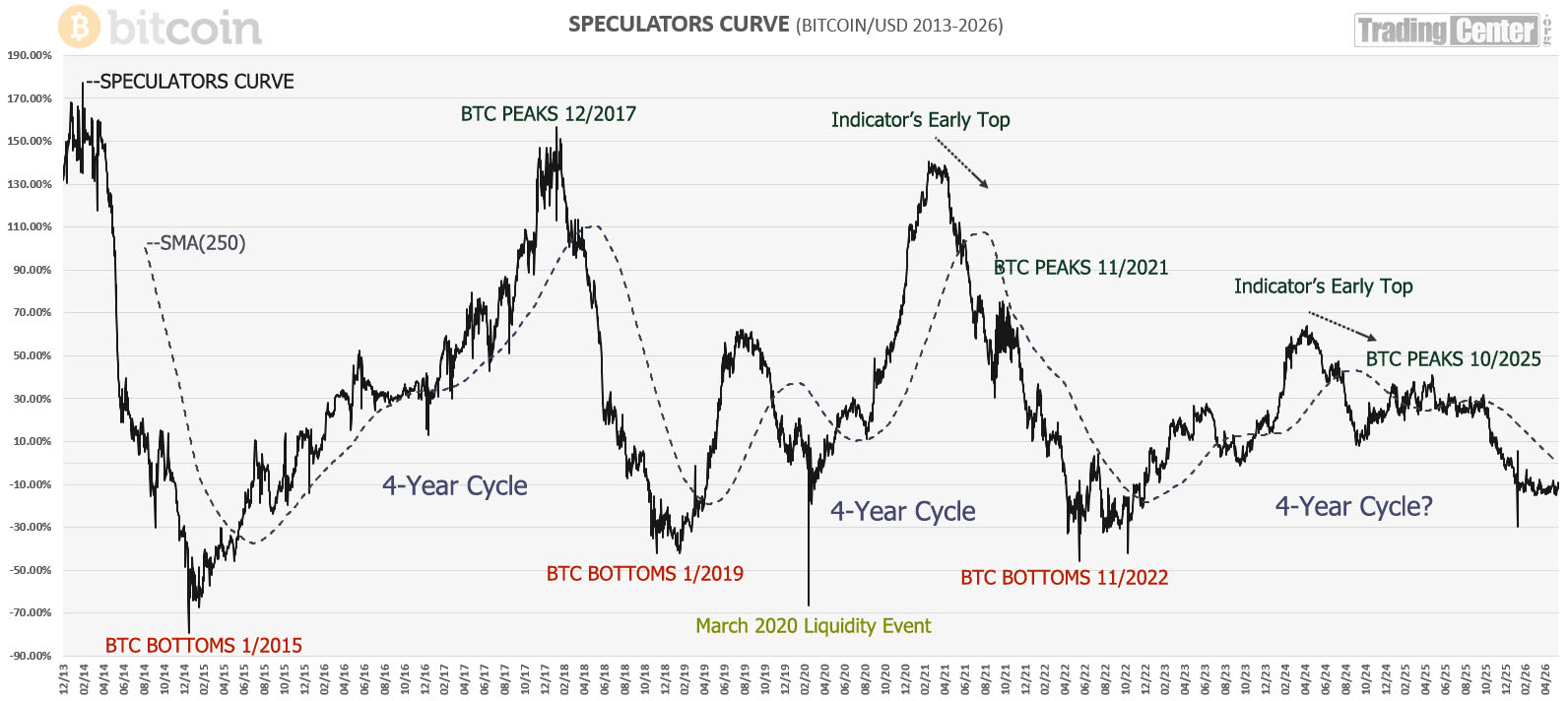
The 200-day structure of the indicator allows cyclical projections and timing estimates for future momentum transitions.

Conclusions on the Future of Bitcoin in 2026-2027
As mentioned in the previous crypto market analysis (November 2025): "Despite the expected bear market, Bitcoin's long-term trend remains bullish... Under the Trump administration, Bitcoin is likely to experience another strong bull run that may stretch into early 2028. Considering all factors, a move into the $45,000-50,000 range could present a good investment opportunity ahead of the next bull phase, projected for 2026-2027."
That argument was valid in November 2025 when Bitcoin was at $92,000, and it holds today, in June 2026, with Bitcoin at $62,000. Nobody knows exactly where the bottom will be. Personally, I see the $45,000-60,000 range as a long-term buying zone. Bitcoin has already recently visited the $60,000 area. The real question, though, is when a powerful market bottom will be formed - something we haven't seen yet. Bitcoin's long-term bottoms typically take the general shape of a double bottom. In the recent 2022 bottom, we saw an initial BTC low at $17,600 in June 2022, followed by a second BTC low at $15,700 in November 2022.
No one can predict with certainty what the 2026 Bitcoin bottom will ultimately look like. However, a probable scenario involves the formation of a second significant low in the coming weeks/months. This second bottom could act as the catalyst for a long-term trend reversal across the broader crypto market.
With that in mind, here are some key technical signals we should look for to confirm a BTC macro bottom:
(1) A well-defined macro bottom pattern on the weekly chart - such as a double bottom or a rounding bottom, both of which are classic long-term reversal formations.
(2) A second macro low formed on elevated volume - strong volume at a re-test low is one of the most reliable confirmation signals of a market bottom.
(3) A bullish divergence on RSI Precision - RSI Precision has formed a clear divergence with the price chart at every major recent market top and bottom (check the chart), making this one of the most important signals to watch.
(4) A breakout of RSI Precision's negative slope - this occurred in late 2022 precisely at the Bitcoin market bottom, and a repeat of this pattern would serve as a strong confirmation that the macro bottom is in.
The more of these signals that align simultaneously, the higher the conviction that a genuine long-term bottom has formed.
■ Introducing the New Indicator 'Speculators Curve' and Using it on Bitcoin/USD (2013-2026)(*)
Giorgos Protonotarios, Financial Analyst
TradingCenter.org (c) - June 12th, 2026
(*) This article is provided solely for analytical and educational purposes and should not be interpreted as investment advice or a recommendation to buy or sell Bitcoin, or any other financial instrument.
L MORE ON TECHNICAL ANALYSIS • COMPARE • TECHNICAL ANALYSIS • INDICATORS • CYCLICAL ANALYSIS • LEARNING
□ Forex Brokers Comparison
□ Expert Advisors (EAs)
□ Broker Reviews
□ Learning
» Technical Analysis Guide
» Trading Chart Patterns
» Naked Charts & Price Zones
» Forex Technical Analysis
» Fibonacci Primes Sequence
» Harmonic Price Patterns
» RSI Precision
» PriceMomentum Chart
» CVD Indicator
» Key Technical Indicators
» ΔMP and Σ(ΔMP) Indicators
» Wyckoff Method
» TD Sequential
» Hurst Nominal Cyclical Model
» Elliott Wave Principle
» Forex Pairs
» Trading Books
» Trading Tips
